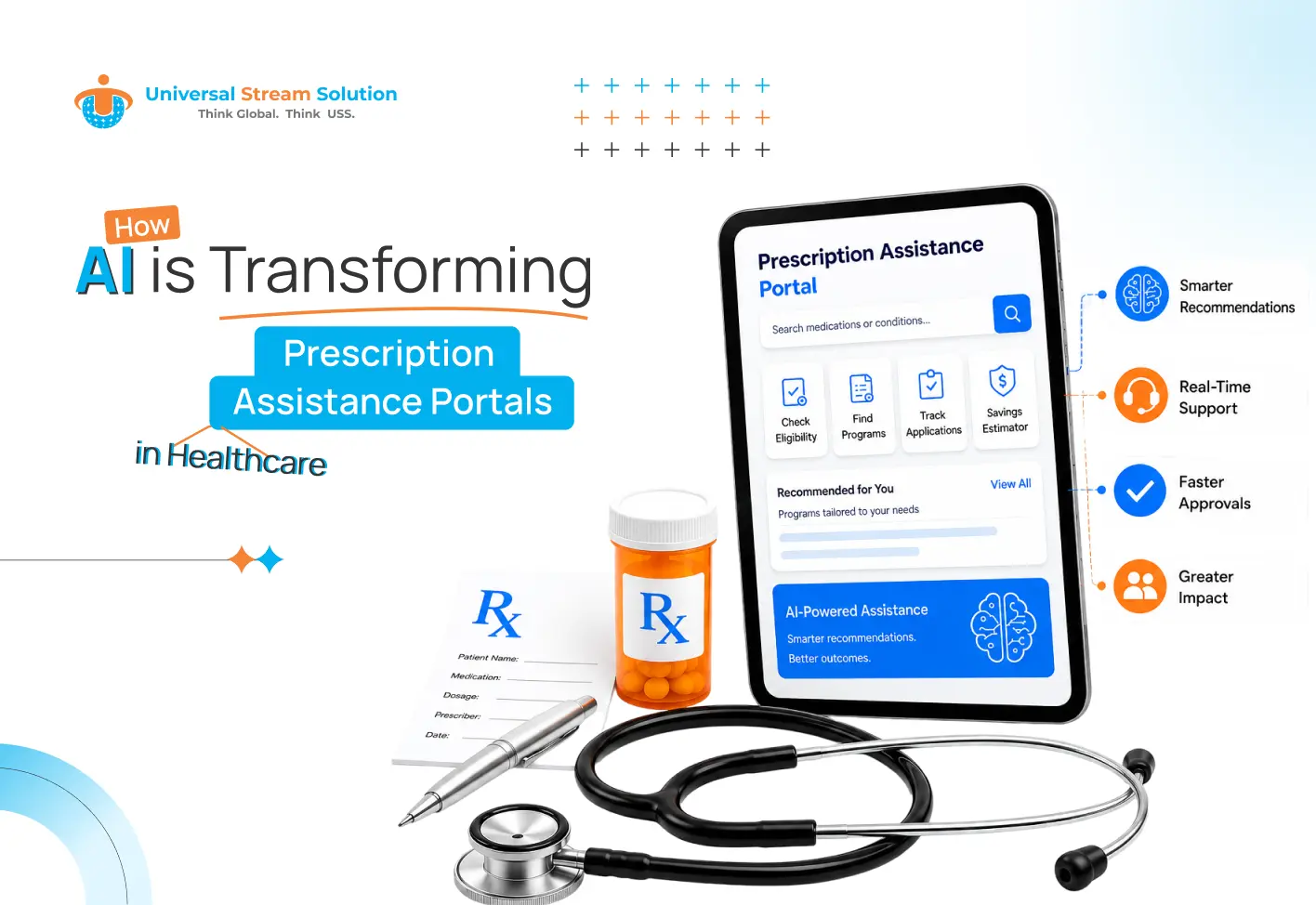
How AI Is Transforming Prescription Assistance Portals in Healthcare

 10th September, 2026
 6 min read


Table Of Contents
- Introduction
- From Static Forms to Smart, Responsive Portals
- What Is a Prescription Assistance Portal?
- How AI Is Improving Prescription Assistance Portals
- The Role of Artificial Intelligence Tools Behind the Scenes
- Privacy, Accuracy, and Human Oversight Matter
- Conclusion
Introduction
Prescription assistance portals have an important part of the healthcare experience, It's portals used to be simple digital forms is helping patients understand medication costs, find financial assistance, complete details, and track the status of support programs. However, many of these processes still involve manual data entry, complex eligibility requirements, phone calls, and long wait times.
Today, Artificial intelligence experience looks very different. Hospitals or pharmacy and network health insurers are rebuilding these portals around intelligent systems that can read a prescription, flag a drug interaction than data analysis, natural language processing, and personalized digital support. Healthcare automation can make prescription assistance easier to navigate while reducing administrative work.
This shift is part of the broader growth of Artificial Intelligence in healthcare, where technology is increasingly being used to support administrative workflows, patient communication, and care delivery. HHS and CMS are also advancing interoperability and electronic prior authorization to reduce administrative friction around access to care.
1. From Static Forms to Smart, Responsive Portals
Older prescription assistance portals work through one-way communication and manual data entry. Patients submit forms and details, and then human reviewers check and validate all the information, such as the disease, insurance, request, and doctor availability.
Newer-generation portals built through modern AI healthcare software development work differently. They can read documents and submitted details, automatically send requests to the right department, check insurance availability faster, guide users, quickly show doctor availability, and ask relevant questions during the process.
To support this process, technologies such as Natural Language Processing (NLP), predictive models, and automated document verification work together.
2. What Is a Prescription Assistance Portal?
A prescription assistance portal is a digital platform that helps patients and healthcare teams manage medication access programs.
Depending on the organization, it may support:
- Prescription assistance program applications
- Patient eligibility screening
- Insurance and benefits information
- Prior authorization workflows
- Financial assistance documentation
- Application status tracking
- Patient notifications
- Communication between patients, providers, pharmacies, and support teams
Traditional portals depend heavily on users entering information manually. This can create friction, particularly when patients need to understand complicated eligibility rules or provide documents from different sources.
AI chatbot can make these interactions more responsive and personalized.
3. How AI Is Improving Prescription Assistance Portals
a. Smarter Eligibility Screening
AI can analyse patient information such as insurance status, medication, income, and program requirements to identify potentially relevant assistance programs. Instead of searching through multiple programs, patients can be guided toward options that may fit their situation. The eligibility result is only an indication, as final approval may require program-specific verification.
b. More Personalized Patient Guidance
Prescription assistance can be confusing when patients are unsure about required documents, submission steps, or application status. Conversational AI can provide step-by-step guidance, explain why a document is needed, remind patients about incomplete sections, and answer common application questions. This is one way AI transforms patient engagement in healthcare by making the digital experience more responsive to patient needs.
c. Automating Administrative Tasks
Healthcare staff often spend significant time reviewing forms, checking information, sending reminders, and updating application statuses. AI and workflow automation can help identify missing information, classify uploaded documents, route requests to the appropriate team, and generate routine notifications. With AI software development, repetitive tasks can be reduced while staff focus on cases that require human judgment or direct patient support.
d. Supporting Prior Authorization
Prior authorization remains a major administrative challenge in healthcare. AI-enabled prescription portals can help organize clinical and administrative information before a request is submitted. They can identify potentially missing documentation, summarize relevant information for staff review, and route authorization requests through the appropriate workflow. AI should support these processes rather than independently replace clinical or coverage decisions.
e. Predictive Reminders and Follow-Up
Patients may miss deadlines, forget to upload documents, or overlook application messages. AI can help identify when follow-up may be useful. A portal can send reminders when an application has been inactive or provide additional guidance when a patient appears to be stuck during the process. This can make prescription assistance more proactive instead of waiting for patients to contact support.
f. Better Integration With Healthcare Systems
Modern prescription assistance platforms increasingly need to connect with electronic health records, payer systems, pharmacy workflows, and other healthcare applications. AI healthcare software development can support this integration and improve information exchange through APIs and standards such as FHIR. The goal is to create a connected workflow where relevant information can move securely between systems while reducing repetitive data entry.
4. The Role of Artificial Intelligence Tools Behind the Scenes
None of this happens without the right technical foundation. Healthcare providers are increasingly relying on a mix of artificial intelligence tools, machine learning models for eligibility prediction, optical character recognition (OCR) for scanning physical prescriptions, and rules-based engines that keep everything aligned with regulatory requirements like HIPAA.
Building these systems responsibly requires careful AI software development practice: rigorous testing, human oversight at key decision points, and transparent logic that can be reviewed when a compliance team or regulator asks how a decision was made. This is a space where accuracy and accountability matter as much as speed, so organisations that invest in this technology tend to work with development teams who understand both software engineering and healthcare regulation.
5. Privacy, Accuracy, and Human Oversight Matter
Prescription assistance portals handle sensitive health and financial information, making privacy and security essential.
AI systems also need safeguards against inaccurate recommendations, incomplete information, bias, and inappropriate automation. Human review remains important when decisions could affect medication access or patient care.
Healthcare organizations should establish clear governance, monitor system performance, protect patient data, and provide patients with ways to reach a human representative when needed.
Conclusion
AI is making prescription assistance portals more useful, easier to navigate, and less dependent on manual processes. From checking eligibility and guiding patients to managing documents, supporting prior authorization, and sending follow-up reminders, these capabilities can help simplify the overall assistance process.
Healthcare organizations, the focus should not be on using AI everywhere, but on using it where it can solve real workflow and patient-access challenges. With proper privacy, security, accuracy checks, and human oversight, AI can support healthcare teams while giving patients a clearer and more convenient way to find and manage prescription assistance.
Jignesh Vaghasiya

Jignesh Vaghasiya is a visionary tech entrepreneur and CEO with over 15 years of experience in driving digital transformation and business growth. He specializes in AI, mobile app innovation, and scalable tech strategies that empower global enterprises.
Related Blogs



 +91 9638225549
 sales@universalstreamsolution.com


