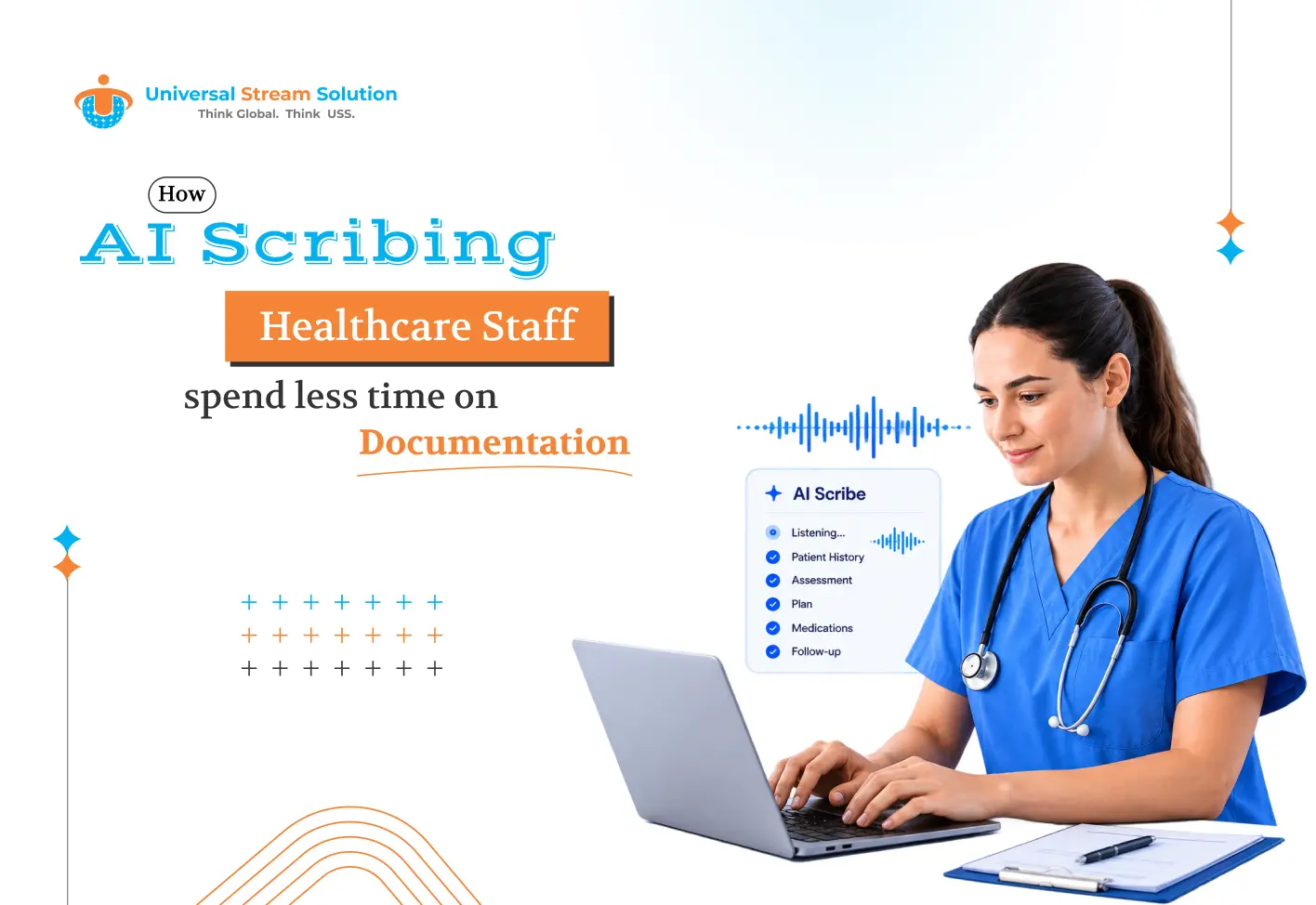
How AI Scribing Helps Healthcare Staff Spend Less Time on Documentation

 12th october, 2026
 6 min read


Table Of Contents
- Introduction
- What Is AI Scribing in Healthcare?
- Why Documentation Takes So Much Time
- How AI Scribing Reduces Documentation Work
- More Time for Patients
- AI Scribing and EHR Integration
- Connecting Documentation With the Larger Healthcare Workflow
- What Healthcare Organizations Should Consider Before Implementing AI Scribing
- The Future of AI Medical Software
- Conclusion
Introduction
Patient documentation is an essential part of healthcare, but it can also take a significant amount of time. Physicians, nurses, and other healthcare professionals may spend hours documenting patient visits, updating records, reviewing notes, and completing administrative tasks after the patient has left.
For USA-based healthcare organizations, the challenge is not whether documentation is necessary. It is how to complete it efficiently without taking attention away from patients.
AI scribing is becoming an important healthcare technology. AI scribes listen to the patient and doctor talk, identify relevant information and create a structured draft of the clinical note for review purposes. Research and real-world implementations have reported reductions in documentation time, although results can vary by workflow, specialty, and implementation.
An AI scribing device uses a microphone to capture the conversation between a healthcare provider and a patient. Using artificial intelligence, speech recognition, and natural language processing, it can identify relevant information from the conversation and help turn it into clinical documentation.
1. What Is AI Scribing in Healthcare?
An AI scribing device uses a microphone to capture the conversation between a healthcare provider and a patient. Using artificial intelligence, speech recognition, and natural language processing, it can identify relevant information from the conversation and help turn it into clinical documentation.
Instead of asking providers to type every detail during or after an appointment, an AI medical scribe can capture the conversation, organise the key information, and create a draft clinical note.
The provider remains in control. They can review the generated note, make corrections, add important details, and approve the final documentation. The goal is not to replace clinical judgment; it is to reduce repetitive documentation work and give healthcare professionals more time to focus on their patients.
Modern AI scribing solutions can also support documentation related to symptoms, medical history, assessments, treatment plans, medications, referrals, and other important details discussed during a patient visit.
2. Why Documentation Takes So Much Time
Documentation involves much more than typing a few sentences.
Healthcare staff may need to:
- Record patient symptoms and medical history
- Document assessments and treatment plans
- Update electronic health records
- Enter medications and orders
- Prepare referrals
- Review previous patient information
- Complete documentation after appointments
- Coordinate information with billing and administrative teams
When these tasks are repeated throughout a busy day, even a few extra minutes per patient can become hours of administrative work each week.
A 2024 healthcare survey cited by reported that 59% of respondents spent five or more hours per week on documentation.
3. How AI Scribing Reduces Documentation Work
An AI scribe can help medical staff move documentation from a manual, after-the-visit task toward a more automated workflow.
During a patient consultation, the system can capture the conversation and convert relevant discussion into structured information. It can then generate a draft note that the provider reviews and edits before finalising.
This can reduce repetitive typing and information entry.
For Example: Instead of spending additional time reconstructing a conversation after a patient visit, a provider can review an AI-generated draft, correct anything necessary, and complete the record.
Recent research has found that ambient AI scribe use can be associated with reductions in documentation time, although the actual benefit depends on the clinical environment and how the technology is used.
4. More Time for Patients
One of the most practical benefits of AI scribing is the potential to reduce screen time during patient discussions.
When providers are not constantly switching between conversation and manual note-taking, they can maintain more attention on the patient.
This does not mean technology should replace documentation. Instead, the goal is to allow technology to handle repetitive documentation while healthcare professionals remain responsible for listening, assessing, communicating, and making clinical decisions.
Healthcare organisations using AI scribing have reported that time saved from documentation can be redirected toward patient care, additional clinical responsibilities, or completing work during normal business hours.
5. AI Scribing and EHR Integration
AI scribing becomes more useful when it works with the healthcare organization's existing technology.
For Example: EHR Software Development can incorporate AI-powered documentation into broader electronic health record workflows. Instead of creating another disconnected application, healthcare organisations can design Software Solutions that connect documentation, patient records, scheduling, billing, and other operational processes.
This is where Custom Software Development can provide flexibility. A healthcare organisation may have specific documentation requirements that cannot be addressed effectively by a generic application.
With the right architecture, .NET Software Development can also be used to build secure healthcare applications, APIs, workflow systems, and integrations that connect different healthcare platforms.
6. Connecting Documentation With the Larger Healthcare Workflow
AI scribing should not be viewed as an isolated technology.
Documentation is connected to many other healthcare processes. Once information is captured correctly, it may support billing, reporting, patient communication, clinical workflows, and administrative operations.
For Example: Organisations investing in Medical Billing Software can consider how clinical documentation connects with billing workflows. Similarly, AI Medical Billing Software can support automation and data processing around revenue-cycle activities.
Other healthcare applications can also benefit from connected workflows, including Hospital Pharmacy Software, patient portals, scheduling systems, and clinical management platforms.
The objective is to create a connected technology environment where information moves efficiently instead of being manually entered multiple times.
7. What Healthcare Organizations Should Consider Before Implementing AI Scribing
AI scribing can provide meaningful workflow benefits, but implementation requires careful planning.
Healthcare organisations should consider:
EHR Integration: Can an AI scribe connect with the organisation's current EHR and workflow?
Accuracy and Review: Can providers easily review, correct, and approve generated documentation?
Privacy and Security: Does the solution support appropriate healthcare data protection and organisational security requirements?
Workflow Fit: Will the technology simplify the existing process or create another system that staff must manage?
Scalability: Can the solution support additional providers, locations, specialties, and future healthcare technology requirements?
A successful implementation should focus on the complete workflow rather than simply adding an AI tool.
8. The Future of AI Medical Software
AI is becoming part of a broader transformation in healthcare technology. AI Medical Software can support documentation, workflow automation, patient communication, medical billing, analytics, and other administrative processes.
AI scribing is one practical solution because it addresses a common problem: the amount of time healthcare professionals spend documenting patient encounters.
The most effective approach is not necessarily about adding more technology. It is about using technology where it can remove repetitive work while keeping healthcare professionals in control of important decisions.
For healthcare organisations considering their next technology investment, AI scribing can be one component of a larger digital strategy that connects EHR systems, billing, pharmacy, patient engagement, and operational workflows.
Conclusion
AI scribing can help healthcare organisations reduce the time and effort spent on routine patient documentation. By capturing patient and doctor conversations and turning relevant information into draft clinical notes, it allows providers to spend less time typing and more time focusing on patient care.
The real value comes when AI scribing works as part of a healthcare technology environment. With the right EHR Software Development, Custom Software Development, and AI Medical Software, organisations can build workflows that connect documentation with billing, patient records, pharmacy, and other daily operations.
If your healthcare team is looking for ways to reduce manual documentation and improve workflow efficiency, exploring an AI-powered software solution could be a practical next step.
Ready to explore a healthcare software solution built around your workflow?
Contact our team to discuss your requirements and find the right approach for your organisation.

Kinjal Vaghasiya

Kinjal Vaghasiya is a healthcare industry expert and digital transformation strategist with over nine years of experience in driving innovation, app development, and AI-powered healthcare solutions. She is passionate about using technology to enhance patient care and operational efficiency.
Related Blogs





 +91 9638225549
 sales@universalstreamsolution.com


