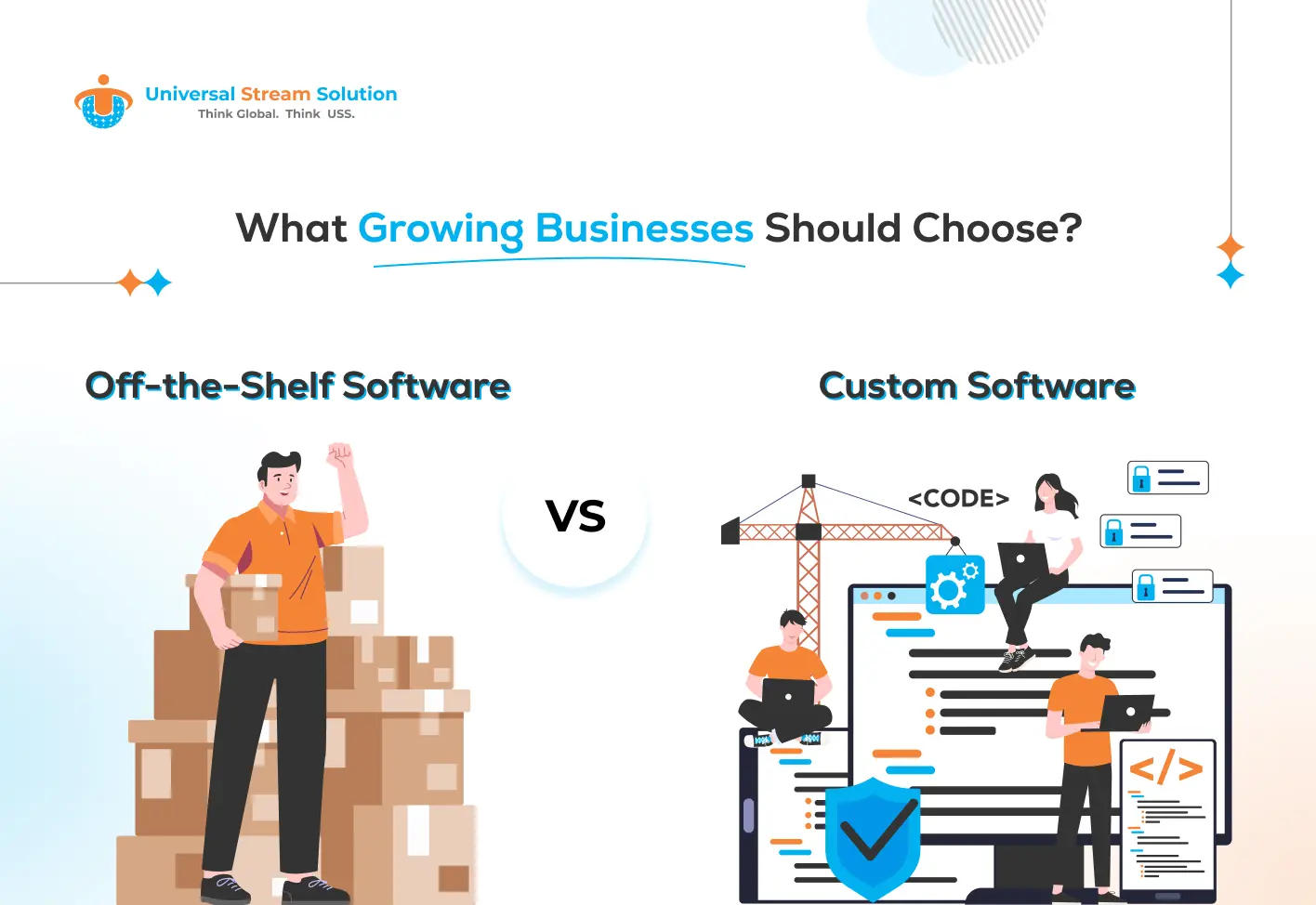
Custom vs Off-the-Shelf Software: What Growing Businesses Should Choose

 19th March, 2026
 6 min read


Table Of Contents
- Introduction
- What is Custom Software?
- What is Off-the-Shelf Software?
- Custom Software vs Off-the-Shelf Software: Key Differences
- Advantages of Custom Software for Growing Businesses
- Advantages of Off-the-Shelf Software
- Challenges of Custom Software
- Challenges of Off-the-Shelf Software
- When Should You Choose Custom Software?
- When Should You Choose Off-the-Shelf Software?
- Hybrid Approach: The Smart Strategy
- Final Thoughts
- Conclusion
Introduction
In today’s competitive and technology-driven business environment, software is no longer just a support tool—it has become the backbone of operations, decision-making, and customer experience. Whether it’s managing internal workflows, handling customer relationships, or automating repetitive tasks, the right software can significantly influence how efficiently a business grows.
As companies expand, their operational complexity increases. This is where one of the most important decisions comes into play: choosing between custom software development and off-the-shelf software solutions. While both options serve the purpose of digitization and efficiency, they differ greatly in terms of flexibility, scalability, cost, and long-term value.
Making the right choice is not just about immediate needs—it’s about ensuring your business is equipped for future challenges and opportunities.
1. What is Custom Software?
Custom software is a fully tailored digital solution designed specifically to meet the unique needs of a business. Unlike generic tools, it is built from scratch or heavily customized to align with a company’s processes, goals, and operational structure—making it the ideal approach to build custom software for business that demands flexibility and precision.
This type of software is especially valuable for organizations with specific workflows or requirements that cannot be fulfilled by standard applications. For example, a company with a unique sales process or a complex inventory system can significantly benefit when they build custom software for business operations instead of relying on generic tools.
Another major advantage of custom software is that it evolves alongside your business. As your company grows, new features, integrations, and functionalities can be added without limitations. This ensures that the solution continues to support your operations effectively, which is why many growing organizations choose to build custom software for business to stay competitive and future-ready.
2. What is Off-the-Shelf Software?
Off-the-shelf software refers to ready-made applications that are designed to cater to a broad range of users and industries. These solutions are pre-built, tested, and available for immediate use, making them a convenient choice for businesses looking for quick implementation.
Such software typically includes widely used tools like customer relationship management (CRM) systems, accounting platforms, and project management applications. They come with a standard set of features that address common business needs.
PaaS offers a managed platform where developers focus only on writing backend code, while the cloud provider handles servers, runtime, scaling, and maintenance.
While off-the-shelf solutions are easy to adopt and cost-effective initially, they often require businesses to adjust their processes to fit the software rather than the other way around. This can sometimes lead to inefficiencies as the business grows and its needs become more complex.
3. Custom Software vs Off-the-Shelf Software: Key Differences
Flexibility and Customization
Flexibility is one of the most defining differences between custom and off-the-shelf software. Custom software is designed with your business in mind, meaning every feature and functionality is aligned with your exact requirements. This allows businesses to operate more efficiently without unnecessary features or limitations.
In contrast, off-the-shelf software offers limited customization. While some tools provide configuration options, they rarely match the level of personalization that custom software offers. Businesses may find themselves working around the software instead of optimizing their processes.
Cost Considerations
Cost is often a deciding factor, especially for startups and small businesses. Off-the-shelf software typically requires a lower upfront investment, making it accessible for companies with limited budgets. However, these solutions often come with recurring subscription fees, licensing costs, and additional charges for upgrades or extra features.
Custom software, on the other hand, involves a higher initial investment due to development costs. However, it eliminates ongoing licensing fees and can significantly reduce inefficiencies, leading to better long-term returns. Over time, many businesses find that custom software is more cost-effective as it aligns perfectly with their operations.
Scalability
Scalability is crucial for growing businesses. Custom software is inherently scalable, allowing companies to add new features, users, and integrations as they expand. This ensures that the software continues to support business growth without requiring a complete overhaul.
Off-the-shelf software may work well in the early stages but can become restrictive as the business grows. Companies often need to invest in additional tools or upgrade to more expensive plans, which can complicate operations and increase costs.
Integration Capabilities
Modern businesses rely on multiple tools and platforms to manage different aspects of their operations. Custom software can be designed to integrate seamlessly with existing systems, ensuring smooth data flow and improved efficiency.
Modern businesses rely on multiple tools and platforms to manage different aspects of their operations. Custom software can be designed to integrate seamlessly with existing systems, ensuring smooth data flow and improved efficiency.
Deployment Time
One of the biggest advantages of off-the-shelf software is its quick deployment. Businesses can start using the software almost immediately after purchase, which is ideal for urgent requirements.
One of the biggest advantages of off-the-shelf software is its quick deployment. Businesses can start using the software almost immediately after purchase, which is ideal for urgent requirements.
Maintenance and Support
Off-the-shelf software providers handle updates, maintenance, and security, reducing the burden on businesses. This makes it a convenient option for companies without a dedicated IT team.
Custom software requires ongoing maintenance and updates, but it offers complete control. Businesses can prioritize features, implement changes quickly, and ensure the software meets their evolving requirements.
4. Advantages of Custom Software for Growing Businesses
It also offers a strong competitive advantage. Businesses can implement unique features and workflows that differentiate them from competitors, helping them stand out in the market. This is why many growing companies invest in custom enterprise software solutions to gain a strategic edge.
Security is another major benefit. Since custom software is built specifically for one organization, it is less likely to be targeted by common cyber threats that affect widely used applications. With custom enterprise software solutions, businesses can also implement advanced security protocols tailored to their specific needs.
Additionally, custom software delivers better long-term ROI. While the initial cost may be higher, the ability to scale, adapt, and optimize processes leads to significant savings over time—making custom enterprise software solutions a smart long-term investment for sustainable growth.
5. Advantages of Off-the-Shelf Software
Off-the-shelf software is an excellent choice for businesses that need a quick and cost-effective solution. It allows companies to start operations without waiting for development, making it ideal for startups and small teams.
These solutions are also reliable, as they are used by a large number of businesses and are continuously tested and improved by vendors. Regular updates ensure that the software remains secure and up-to-date with industry standards.
Another advantage is the availability of customer support and training resources, which helps businesses adopt the software more easily.
6. Challenges of Custom Software
Despite its benefits, custom software comes with certain challenges. The initial development cost can be significant, which may not be feasible for all businesses.
The development process also requires time and collaboration, which can delay implementation. Additionally, businesses need access to technical expertise to manage and maintain the software effectively.
However, these challenges can be managed with proper planning and the right development partner.
7. Challenges of Off-the-Shelf Software
Off-the-shelf software may seem convenient, but it has its limitations. The lack of customization can restrict business operations, especially as requirements become more complex.
Recurring costs can also add up over time, making it more expensive in the long run. Businesses are also dependent on vendors for updates and changes, which may not always align with their priorities.
In some cases, businesses may outgrow the software entirely, requiring a transition to a more flexible solution.
8. When Should You Choose Custom Software?
Custom software is the right choice when your business has unique requirements that cannot be met by standard tools. It is particularly beneficial for companies that are scaling rapidly and need a solution that can grow with them, especially when they stay updated with modern app development trends to remain competitive.
If your operations require complex integrations, advanced features, or complete control over data and processes, custom software becomes a strategic investment. Businesses that stay updated with modern app development trends are better positioned to build scalable, future-ready solutions that adapt to evolving market demands.
9. When Should You Choose Off-the-Shelf Software?
Off-the-shelf software is ideal for businesses that need a quick, affordable, and easy-to-use solution. It works well for companies with standard requirements and limited budgets.
It is also a good starting point for startups that are still defining their processes and do not yet require a highly customized solution.
10. Hybrid Approach: The Smart Strategy
Many businesses adopt a hybrid approach, combining the benefits of both custom and off-the-shelf software. They start with ready-made tools to manage initial operations and gradually transition to custom solutions as their needs evolve.
This approach allows businesses to balance cost, speed, and scalability while minimizing risks.
11. Final Thoughts
Choosing between custom and off-the-shelf software is a strategic decision that can shape the future of your business. While off-the-shelf solutions offer convenience and affordability, custom software provides the flexibility and scalability needed for long-term growth.
The key is to evaluate your business needs, goals, and resources carefully before making a decision.
Conclusion
There is no one-size-fits-all answer when it comes to choosing the right software. The best solution depends on your business stage, operational complexity, and growth plans.
For businesses aiming to scale and innovate, custom software often proves to be the better investment. However, for those looking for quick and cost-effective solutions, off-the-shelf software remains a practical choice.
Ultimately, the right software should empower your business, not limit it.

Bharat Katariya

Bharat Katariya is a seasoned executive at Universal Stream Solution LLC, bringing a strong track record of leadership and commercial strategy. With robust experience in driving business growth and operational transformation, he empowers organizations to build scalable, efficient solutions. Bharat is committed to delivering strategic value through innovation, collaboration, and integrity.
Related Blogs




 +91 9638225549
 sales@universalstreamsolution.com


