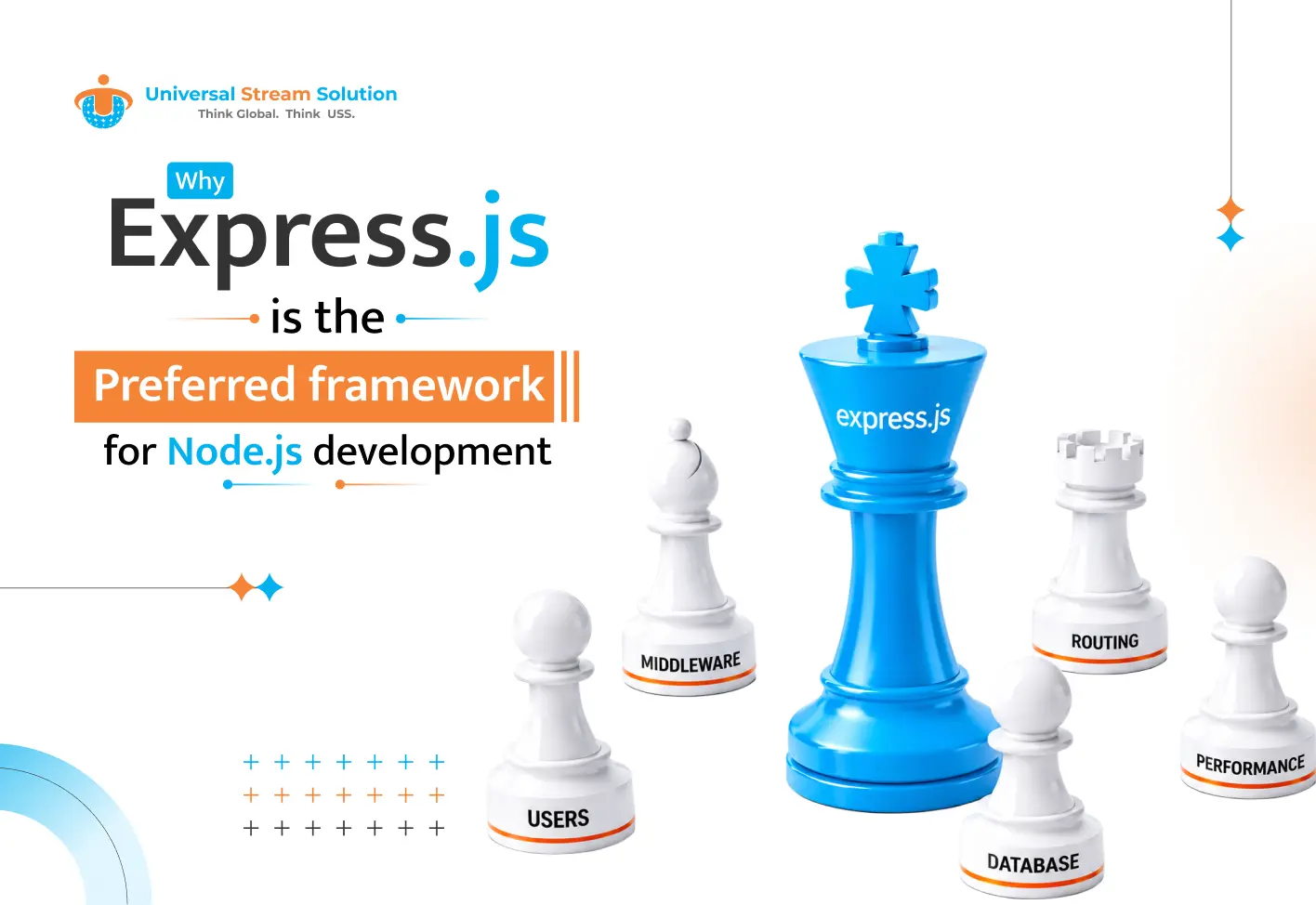
Why Express.js Is the Preferred Framework for Node.js Development

 22nd September, 2026
 6 min read


Table Of Contents
- Introduction
- What Is Express.js and Why Is It Used With Node.js?
- Understanding Express.js Architecture
- Why Express.js Works Well for Web Application Development
- Is Express.js Good for Node.js Development?
- Express.js for Custom Healthcare Software
- When Should a Business Choose Express.js?
Introduction
When an organisation plans a new web application, the backend framework can have a lasting impact on development, maintenance, integrations, and future growth. For organisations using Node.js, Express.js is one of the most widely considered options because it offers a simple foundation without placing unnecessary restrictions on how an application should be built.
Express.js is a simple and scalable Node.js web app framework. It provides practical features for routing, middleware, HTTP requests, and API development while allowing developers to decide how the rest of the application should be organised. This balance is suitable for everything from small applications to big digital platforms.
1. What Is Express.js and Why Is It Used With Node.js?
Express.js is a Node.js web framework that makes it easier to create and manage web servers and APIs. It helps handle requests and responses, manage routes, run server-side code, and add features such as authentication and security.
In a Node.js provides the runtime environment for executing JavaScript on the server. Express.js works on top of Node.js and simplifies many of the tasks involved in creating a backend application.
Developers can use Express.js to create routes, process incoming requests, return responses, build APIs, manage middleware, and connect different application services. Rather than creating these functions independently, teams can use Express as a starting point and customize the rest of the technology stack around the project's needs.
This flexibility is particularly useful when a business expects its application to evolve over time.
2. Understanding Express.js Architecture
Architecture is most important aspects to understand when evaluating Express.js. Unlike some frameworks that provide a highly prescribed application structure, Express.js gives developers more freedom to organise code.
A typical Express.js application can be divided into several layers:
Routes
Routes explain how the application responds to requests to specific URLs and HTTP methods. For EX: separate routes can handle customers, products, payments, appointments, or user accounts.
Keeping routes organized by business function makes a larger application easier to navigate.
Middleware
Middleware functions rest between a request and the final response. They can perform specific tasks before the request passes to the main application logic.
Common examples include authentication, authorisation, request validation, logging, error handling, and data processing.
Controllers
Controllers handle the application's request-and-response logic. They receive information from routes, call the appropriate business services and determine what information should be returned to the client.
Separating this responsibility from routing can make the application easier to maintain.
Services
The service layer generally contains business rules and application-specific operations.
For EX: A healthcare application might have services for patient records, appointments, Patient billing, or notifications.
Keeping business logic separate from routes helps developers update individual functions without affecting unrelated parts of the system.
Data Access Layer
It handles communication with the database and other data sources. It takes care of common operations such as fetching, adding, updating, and deleting data.
Separating data access from the main application logic makes the code easier to maintain and makes it simpler to switch or update the database in the future.
Database
Express.js developer doesn't need to use a particular database. A project can use a database technology that matches its data requirements, expected performance and existing infrastructure.
One more example of the framework's flexible approach.
API Response
After the request passes through the necessary layers, the application sends a response back to the client. This could be data for a web interface, information requested by a mobile application, or a response consumed by another service.
Client → Routes → Middleware → Controllers → Services → Data Access → Database → Response
This structure is not mandatory for every Express project. The exact architecture should be determined by application complexity and business requirements.
3. Why Express.js Works Well for Web Application Development
A major reason companies consider Express.js is that it provides the basic backend capabilities developers need without creating excessive complexity.
Lightweight and Flexible
Express.js follows a minimalist approach. Developers can add only the libraries and components required by the application instead of working with a large collection of built-in features.
This gives development teams more control over technology choices and application structure.
Easy API Development
Modern applications regularly rely on APIs to connect websites, mobile app, payment platforms, CRM systems, databases, and third-party services.
Express.js provides routing and HTTP capabilities that make it practical for developing these APIs. This can be especially useful for businesses planning products that need several connected systems.
Modular Development
Modular development through routing and middleware. Different parts of an app can be separated into manageable components instead of keeping everything in one large codebase.
As new features are introduced, developers can expand the application without necessarily transforming the entire backend.
Large Node.js Ecosystem
Express.js benefits from the broader Node.js ecosystem. Developers have access to a wide range of packages and tools for authentication, validation, database connectivity, testing, security, logging, and other application requirements.
This can help teams select established solutions instead of developing every supporting feature internally.
4. Is Express.js Good for Node.js Development?
Many projects, yes. Express.js is a practical Node.js backend framework when flexibility, API development, and a relatively lightweight architecture are important considerations.
It can be suitable for SaaS platforms, e-commerce applications, customer portals, business applications, mobile backends and enterprise systems.
Express.js should not be selected simply because it is popular. The right technology depends on the application's functionality, expected workload, security requirements, integrations, development team, and long-term maintenance plans.
5. Express.js for Custom Healthcare Software
Healthcare applications often have more complex requirements than standard business software. They may involve multiple user roles, sensitive information, clinical workflows, external integrations, audit requirements, and strict access controls.
For organisations developing Custom Healthcare Software, Express.js can be used as part of a backend architecture when its capabilities align with the project's requirements.
For EX: Custom EMR Solutions may need to connect patient information, healthcare professionals, administrative users, scheduling systems, billing functions, and external healthcare services.
In these situations, the framework itself is only one component of the solution. Application architecture, security controls, data management, infrastructure, monitoring, and compliance considerations should be addressed from the beginning.
When Should a Business Choose Express.js?
The right project structure depends on the type and requirements of the project. Express.js can be used to build a wide range of applications like E-Commerce APIs, Food Delivery APIs, Real-Time Chat applications and many other backend systems.
Express.js is a strong choice when a project needs a flexible backend, API-driven functionality, modular development, and access to the Node.js ecosystem. It gives developers the freedom to organise the application based on their specific needs instead of forcing them to follow a fixed or rigid structure.
For businesses that already have a Node.js development team, Express.js can also be a familiar and practical foundation for building, maintaining, and scaling server-side applications.
Ready to Discuss Your Project?
Whether you're planning a new web application, upgrading an existing backend, or exploring Healthcare Technology solutions, an initial technical discussion can help you understand whether Express.js and Node.js are the right fit.

Arzeb Mansuri

Arzeb Mansuri is a full-stack developer with expertise in Next.js, React.js, Node.js, TypeScript, JavaScript and PHP, delivering high-quality digital solutions in fast-moving environments. With a strong focus on building user-centric web applications, Arzeb helps organizations enhance their digital presence and operational performance.
Related Blogs




 +91 9638225549
 sales@universalstreamsolution.com


