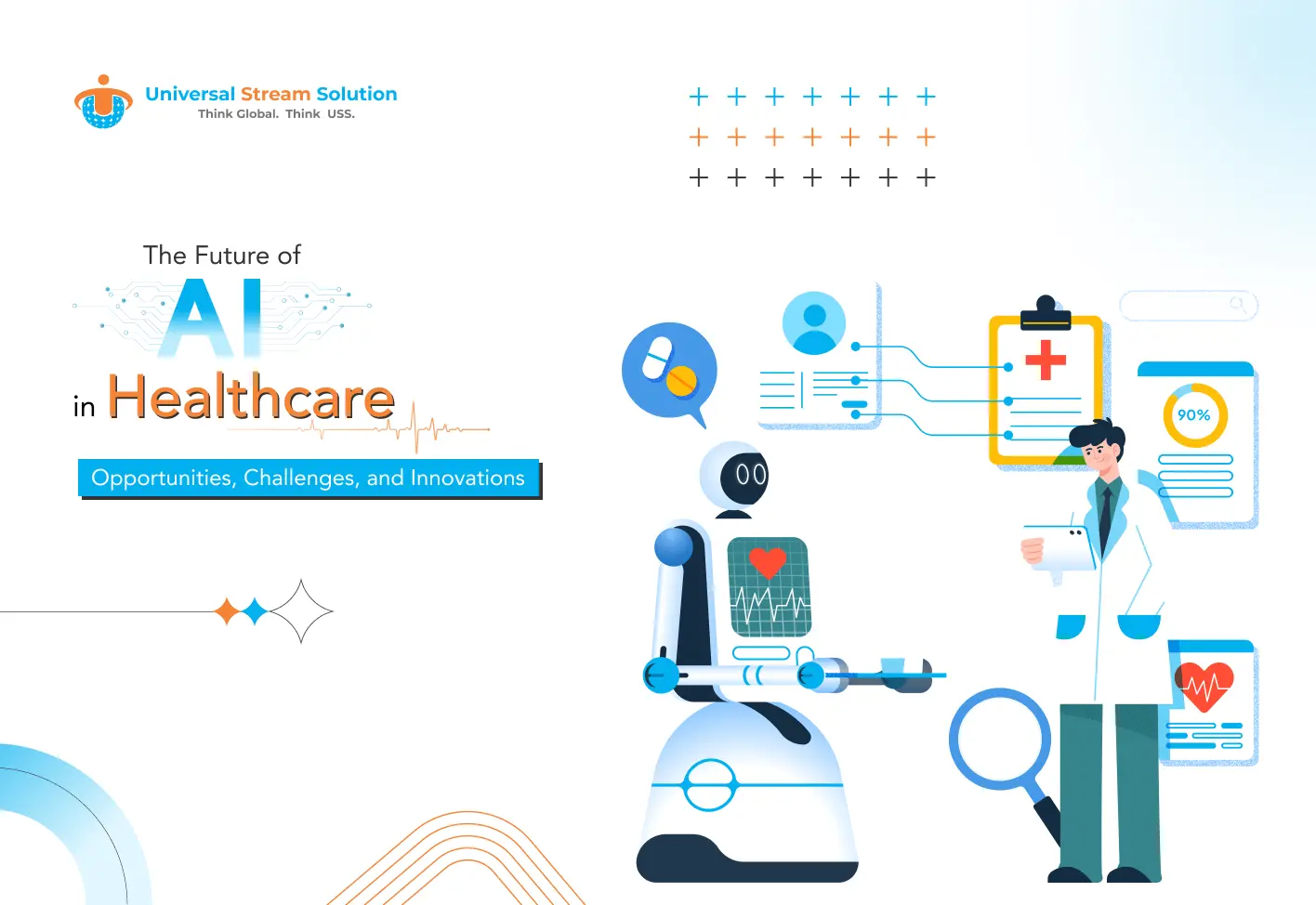
The Future of AI in Healthcare: Opportunities, Challenges, and Innovations

 8th July, 2026
 6 min read


Table Of Contents
- Introduction
- What is AI in Healthcare?
- Why AI is Becoming Essential in Healthcare
- Major Opportunities of AI in Healthcare
- Emerging AI Innovations Transforming Healthcare
- Challenges of AI in Healthcare
- How AI is Improving Patient Experience
- The Future of AI in Healthcare
- Conclusion
Introduction
Artificial Intelligence (AI) is no longer a futuristic concept in healthcare—it is rapidly transforming how hospitals, clinics, pharmaceutical companies, and healthcare providers deliver care. From improving diagnostic accuracy to streamlining administrative workflows, AI is reshaping every aspect of the healthcare ecosystem.
As healthcare organizations face increasing patient demands, workforce shortages, rising operational costs, and the need for better patient outcomes, AI has emerged as a powerful technology that helps solve these challenges. It enables healthcare professionals to make faster decisions, improve treatment accuracy, automate repetitive tasks, and deliver personalized patient experiences.
According to industry reports, the global AI healthcare market is expected to grow significantly over the next decade, driven by advancements in machine learning, natural language processing, predictive analytics, and generative AI.
In this article, we'll explore the future of AI in healthcare, the opportunities it creates, the challenges organizations must overcome, and the innovations that are shaping the next generation of digital healthcare.
1. What is AI in Healthcare?
Artificial Intelligence in healthcare refers to the use of intelligent computer systems that can analyze medical data, identify patterns, support clinical decisions, automate processes, and improve patient care.
Unlike traditional software, AI systems continuously learn from data and improve their performance over time. They can process millions of patient records, medical images, laboratory reports, and clinical notes much faster than humans.
Healthcare organizations are now integrating AI into:
- Medical imaging
- Electronic Health Records (EHR)
- Drug discovery
- Patient engagement
- Virtual health assistants
- Hospital operations
- Predictive analytics
- Medical billing
- Remote patient monitoring
- Personalized treatment planning
The goal is not to replace healthcare professionals but to enhance their capabilities with data-driven insights and intelligent automation.
2. Why AI is Becoming Essential in Healthcare
Modern healthcare generates enormous amounts of data every day, making manual management increasingly difficult. How AI is transforming telemedicine is a clear example of how intelligent technologies can analyze patient data, automate routine tasks, and support remote healthcare services. From virtual consultations to real-time patient monitoring, AI enables healthcare providers to deliver faster, more accurate, and personalized care while improving operational efficiency.
AI helps healthcare providers:
- Improve diagnostic accuracy
- Reduce medical errors
- Enhance patient outcomes
- Optimize hospital resources
- Reduce operational costs
- Support evidence-based treatment decisions
- Increase efficiency across departments
With aging populations and increasing chronic diseases worldwide, AI offers scalable solutions that help healthcare systems deliver better care with limited resources.
3. Major Opportunities of AI in Healthcare
Faster and More Accurate Disease Diagnosis
One of the biggest advantages of AI is its ability to analyze medical images and patient data quickly.
AI-powered diagnostic systems can detect:
- Cancer
- Heart disease
- Stroke
- Pneumonia
- Diabetic retinopathy
- Neurological disorders
These systems assist radiologists and physicians by identifying abnormalities that may be difficult to detect with the human eye.
Earlier diagnosis often leads to earlier treatment and improved patient outcomes.
Personalized Patient Care
Every patient is different.
AI helps healthcare providers create personalized treatment plans by analyzing:
- Medical history
- Lifestyle
- Genetic information
- Current medications
- Lab reports
- Previous treatments
Instead of using a one-size-fits-all approach, physicians can recommend treatments tailored to each patient's unique needs.
Personalized medicine is expected to become one of the biggest advancements in healthcare over the next decade.
Predictive Analytics for Better Healthcare
AI can predict health risks before symptoms become severe.
Hospitals use predictive analytics to identify patients who may be at risk of:
- Heart attacks
- Sepsis
- Hospital readmission
- Diabetes complications
- Disease progression
This allows healthcare providers to intervene early, reducing emergency admissions and improving long-term health outcomes.
AI-Powered Medical Imaging
Medical imaging has seen some of the fastest AI adoption.
AI assists specialists by analyzing:
- X-rays
- CT scans
- MRI scans
- Mammograms
- Ultrasounds
Benefits include:
- Faster reporting
- Higher diagnostic accuracy
- Reduced workload for radiologists
- Early disease detection
AI serves as a decision-support tool rather than replacing clinical expertise.
Virtual Health Assistants and Chatbots
AI-powered virtual assistants are improving patient communication around the clock.
Patients can:
- Book appointments
- Receive medication reminders
- Check symptoms
- Access health information
- Schedule follow-up visits
- Receive post-treatment guidance
This improves patient engagement while reducing administrative burdens on healthcare staff.
Drug Discovery and Development
Developing a new drug traditionally takes years and billions of dollars.
AI accelerates this process by:
- Identifying promising compounds
- Predicting drug interactions
- Analyzing molecular structures
- Optimizing clinical trial recruitment
This reduces research time and speeds up the availability of life-saving treatments.
Remote Patient Monitoring
Wearable devices combined with AI are enabling continuous health monitoring.
Healthcare providers can monitor:
- Blood pressure
- Heart rate
- Blood glucose
- Oxygen saturation
- Sleep quality
- Physical activity
AI detects abnormal patterns and alerts healthcare professionals before conditions worsen.
This is particularly valuable for patients with chronic diseases.
Administrative Automation
Healthcare professionals spend a significant amount of time on paperwork.
AI automates tasks such as:
- Medical documentation
- Insurance verification
- Medical coding
- Claims processing
- Appointment scheduling
- Billing
- Patient record management
Automation reduces administrative costs while allowing healthcare providers to focus more on patient care.
4. Emerging AI Innovations Transforming Healthcare
Healthcare AI continues to evolve rapidly.
Some of the most promising innovations include:
Generative AI for Clinical Documentation
Generative AI can automatically summarize doctor-patient conversations into structured clinical notes, reducing documentation time.
AI Digital Twins
Digital twins simulate a patient's biological systems, helping physicians test treatment options virtually before applying them in real life.
AI in Robotic Surgery
AI-assisted robotic systems improve surgical precision, reduce complications, and support minimally invasive procedures.
Precision Medicine
AI combines genomic data, lifestyle information, and clinical records to recommend highly personalized therapies.
AI-Powered Mental Health Support
AI-driven platforms help screen for anxiety, depression, and stress while providing early intervention and ongoing patient support.
Intelligent Hospital Management
AI optimizes bed allocation, staffing, equipment utilization, and emergency department workflows to improve operational efficiency.
5. Challenges of AI in Healthcare
Despite its benefits, AI adoption comes with important challenges.
Data Privacy and Security
Healthcare data is highly sensitive.
Organizations must ensure compliance with regulations and implement strong cybersecurity measures to protect patient information from breaches.
Data Quality
AI systems are only as effective as the data used to train them.
Incomplete or inaccurate medical records can reduce AI accuracy and lead to poor recommendations.
Healthcare organizations need standardized, high-quality datasets for reliable AI performance.
Bias in AI Models
AI algorithms can inherit biases from the data they learn from.
If training data lacks diversity, AI recommendations may be less accurate for certain patient populations.
Developers must continuously evaluate and improve models to ensure fairness and inclusivity.
Integration with Existing Systems
Many healthcare providers still rely on legacy software.
Integrating AI with Electronic Health Records (EHR), Hospital Information Systems (HIS), and other platforms can be technically challenging and require careful planning.
Regulatory Compliance
Healthcare is one of the most regulated industries.
AI solutions must meet strict legal, ethical, and regulatory requirements before they can be deployed in clinical settings.
Organizations should ensure transparency, explainability, and ongoing monitoring of AI systems.
Workforce Adoption
Successful AI implementation requires training healthcare professionals to work effectively alongside intelligent technologies.
Building trust, providing education, and demonstrating measurable value are essential for widespread adoption.
6. How AI is Improving Patient Experience
Patient expectations continue to evolve, and AI helps healthcare providers deliver faster, more personalized, and more convenient care. AI in prescription management is also transforming how medications are prescribed, tracked, and delivered by reducing errors, automating workflows, and improving access to treatment. This enables healthcare organizations to enhance patient experiences while ensuring safer and more efficient medication management.
Examples include:
- 24/7 virtual support
- Shorter wait times
- Faster diagnosis
- Personalized treatment recommendations
- Remote consultations
- Continuous health monitoring
- Better follow-up care
- Improved medication adherence
The result is a more connected and patient-centered healthcare experience.
7. The Future of AI in Healthcare
The future of healthcare will combine AI with technologies such as cloud computing, the Internet of Things (IoT), wearable devices, robotics, and advanced analytics.
Future developments may include:
- AI-powered preventive healthcare
- Fully integrated smart hospitals
- Advanced precision medicine
- Predictive population health management
- Autonomous clinical documentation
- Intelligent healthcare workflows
- AI-assisted surgery with greater precision
- Faster clinical research and drug development
- Real-time decision support for clinicians
Rather than replacing doctors, AI will become an intelligent partner that enhances human expertise and helps healthcare teams deliver safer, faster, and more effective care.
Organizations that invest in responsible AI adoption today will be better positioned to improve operational efficiency, reduce costs, and deliver exceptional patient outcomes in the years ahead.
Conclusion
Artificial Intelligence is redefining the future of healthcare by enabling smarter clinical decisions, improving patient experiences, streamlining operations, and accelerating medical innovation. While challenges such as data privacy, system integration, and regulatory compliance remain, the potential benefits far outweigh the obstacles when AI is implemented responsibly.
Healthcare providers that embrace AI strategically can improve diagnostic accuracy, automate administrative tasks, enhance personalized care, and create more efficient healthcare systems. As AI technologies continue to evolve, they will play an increasingly important role in building a more connected, data-driven, and patient-centric healthcare ecosystem. Talk to Our Healthcare IT Experts to discover how AI-powered healthcare solutions can help your organization accelerate digital transformation, improve operational efficiency, and deliver better patient outcomes.
The future of AI in healthcare is not about replacing healthcare professionals—it's about empowering them with intelligent tools that support better decisions, better care, and better health outcomes for everyone.

Kinjal Vaghasiya

Kinjal Vaghasiya is a healthcare industry expert and digital transformation strategist with over nine years of experience in driving innovation, app development, and AI-powered healthcare solutions. She is passionate about using technology to enhance patient care and operational efficiency.
Related Blogs





 +91 9638225549
 sales@universalstreamsolution.com


