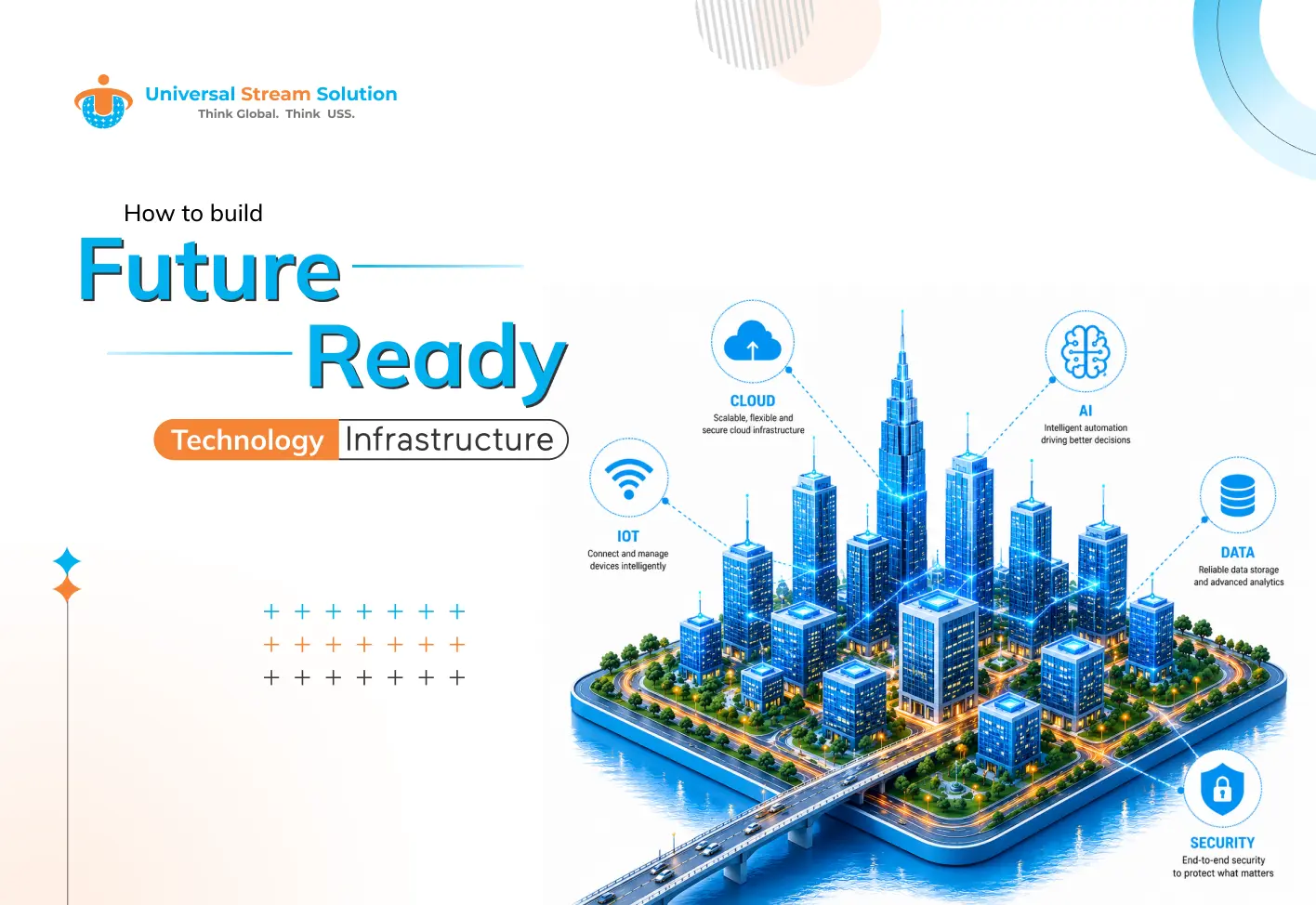
How to Build a Future-Ready Technology Infrastructure

 3rd August, 2026
 6 min read


Table Of Contents
- Introduction
- What Is a Future-Ready Technology Infrastructure?
- Why Modern Technology Infrastructure Matters
- Key Components of a Future-Ready Technology Infrastructure
- Benefits of Investing in Modern Technology Infrastructure
- Steps to Build a Future-Ready Technology Infrastructure
- Monitor and Optimize
- Common Mistakes Businesses Should Avoid
- Industries That Benefit from Future-Ready Infrastructure
- Why Partner with a Technology Solutions Provider?
- Final Thoughts
Introduction
Technology is evolving faster than ever. Businesses that rely on outdated systems often struggle with slow performance, security risks, rising maintenance costs, and limited scalability. As customer expectations continue to increase, organizations need an IT infrastructure that is flexible, secure, and ready for future innovation.
A future-ready technology infrastructure is more than upgrading hardware or moving applications to the cloud. It is about creating a technology ecosystem that supports business growth, improves operational efficiency, enhances security, and adapts to changing market demands.
Whether you're a startup, mid-sized business, or enterprise, investing in modern infrastructure helps reduce costs, improve productivity, and stay competitive in a rapidly changing digital landscape.
1. What Is a Future-Ready Technology Infrastructure?
A future-ready technology infrastructure is a combination of modern software, cloud platforms, networking, cybersecurity, automation, and scalable architecture that enables businesses to quickly adapt to new technologies and changing customer needs.
Unlike traditional IT environments, modern infrastructure is designed for:
- Scalability
- High availability
- Better security
- Faster deployment
- Easy integration
- Improved performance
- Business continuity
Instead of constantly replacing outdated systems, organizations can continuously evolve their technology stack.
2. Why Modern Technology Infrastructure Matters
Many businesses continue to rely on legacy systems built years ago. While these systems may still function, they often create operational challenges.
Common problems include:
- Slow application performance
- High infrastructure maintenance costs
- Security vulnerabilities
- Difficult software integration
- Limited remote accessibility
- Poor customer experience
- Downtime during business growth
Modern infrastructure solves these challenges by providing a flexible foundation that grows alongside the business.
3. Key Components of a Future-Ready Technology Infrastructure
Cloud-First Architecture
Cloud computing has transformed how businesses manage applications and data.
Instead of relying entirely on physical servers, organizations can use cloud services to increase flexibility and reduce infrastructure costs.
Benefits include:
- Faster deployment
- Automatic scalability
- Lower hardware investment
- Disaster recovery
- Global accessibility
- Improved collaboration
Businesses can choose between public cloud, private cloud, or hybrid cloud environments depending on compliance and operational requirements.
Scalable Software Architecture
As businesses grow, software should grow with them.
Applications built using modular architecture, APIs, and microservices are easier to maintain and expand than traditional monolithic systems.
Scalable architecture allows organizations to:
- Add new features quickly
- Handle increased user traffic
- Reduce downtime
- Improve application performance
- Simplify maintenance
This flexibility helps businesses respond faster to market changes.
Strong Cybersecurity Framework
Cyber threats continue to evolve every year.
Modern infrastructure must include security at every layer instead of treating it as an afterthought.
Essential security measures include:
- Multi-factor authentication
- Data encryption
- Identity and access management
- Endpoint protection
- Network monitoring
- Security audits
- Vulnerability assessments
- Backup and disaster recovery
Building security into the infrastructure reduces the risk of costly data breaches.
Automation and DevOps
Manual deployment processes often slow down software development.
DevOps practices combine development and operations teams to automate software delivery and infrastructure management.
Automation helps businesses:
- Deploy software faster
- Reduce human errors
- Improve testing
- Monitor system health
- Accelerate updates
Continuous Integration (CI) and Continuous Deployment (CD) pipelines improve software quality while reducing release time.
Data-Driven Decision Making
Data has become one of the most valuable business assets.
A future-ready infrastructure should include modern data management solutions that enable real-time insights.
Organizations should invest in:
- Data warehouses
- Business intelligence tools
- Analytics dashboards
- AI-powered reporting
- Centralized data storage
Accurate data helps leaders make informed business decisions.
API Integration
Modern businesses use multiple software platforms.
Without proper integration, employees waste time manually transferring information between systems.
API-driven infrastructure enables seamless communication between:
- CRM systems
- ERP software
- Accounting platforms
- Marketing tools
- Customer portals
- Mobile applications
- Payment gateways
This improves productivity and eliminates data silos.
Mobile-Ready Infrastructure
Today's workforce expects access from anywhere.
Cloud-enabled applications and responsive systems allow employees to work securely across devices.
Mobile accessibility improves:
- Employee productivity
- Customer engagement
- Remote collaboration
- Business continuity
Supporting hybrid work environments has become essential for many organizations.
AI and Intelligent Automation
Artificial Intelligence is becoming part of everyday business operations.
Organizations are using AI to automate repetitive tasks, improve customer service, and analyze business data.
Examples include:
- AI chatbots
- Predictive analytics
- Intelligent document processing
- Recommendation engines
- Workflow automation
A future-ready infrastructure should support AI integration as business requirements evolve.
4. Benefits of Investing in Modern Technology Infrastructure
Businesses that modernize their infrastructure often experience measurable improvements across operations. As AI continues to drive digital transformation, organizations can Discover the Right AI Solution for Your Business by adopting scalable, secure, and future-ready technologies that align with their long-term goals.
Key benefits include:
Improved Scalability
Infrastructure grows alongside business demand without major system redesign.
Better Performance
Modern platforms provide faster application response times and improved user experiences.
Increased Security
Advanced security frameworks help protect sensitive business and customer information.
Lower Operational Costs
Cloud services reduce hardware investments and maintenance expenses.
Faster Innovation
Development teams can launch new products and features more quickly.
Business Continuity
Reliable backup systems and disaster recovery minimize downtime during unexpected events.
5. Steps to Build a Future-Ready Technology Infrastructure
Assess Your Existing Environment
Start by evaluating your current infrastructure.
Identify:
- Outdated systems
- Security gaps
- Performance bottlenecks
- Integration challenges
- Maintenance costs
A technology assessment helps prioritize modernization efforts.
Define Business Objectives
Technology should support business goals.
Consider questions such as:
- Will the business expand internationally?
- Are remote teams increasing?
- Is customer demand growing?
- Will AI become part of operations?
- Do compliance requirements apply?
Clear objectives help guide infrastructure investments.
Develop a Modernization Roadmap
Rather than replacing everything at once, create a phased implementation strategy.
Typical phases include:
- Infrastructure assessment
- Cloud migration
- Application modernization
- Security enhancement
- Process automation
- Continuous optimization
This reduces operational disruption while managing costs.
Invest in Scalable Technologies
Choose technologies that support future expansion.
Examples include:
- Cloud platforms
- Containerization
- API-first development
- Serverless computing
- Modern databases
Scalable technologies reduce future migration costs.
Prioritize Cybersecurity
Security should be integrated throughout every phase of modernization.
Best practices include:
- Zero Trust Architecture
- Employee security training
- Continuous monitoring
- Incident response planning
- Regular penetration testing
Proactive security reduces organizational risk.
6. Monitor and Optimize
Technology infrastructure should continuously evolve.
Use monitoring tools to measure:
- System uptime
- Performance
- Security events
- Infrastructure utilization
- Customer experience
Regular optimization ensures long-term success.
7. Common Mistakes Businesses Should Avoid
Many digital transformation projects fail because organizations focus only on technology.
Avoid these common mistakes:
- Ignoring business goals
- Delaying security planning
- Choosing technologies without scalability
- Overlooking employee training
- Failing to integrate existing systems
- Not creating disaster recovery plans
- Skipping ongoing maintenance
Successful modernization combines people, processes, and technology.
8. Industries That Benefit from Future-Ready Infrastructure
Nearly every industry benefits from modern technology infrastructure.
These include:
- Healthcare
- Financial Services
- Manufacturing
- Retail
- Education
- Logistics
- Real Estate
- Hospitality
- Insurance
- Professional Services
Organizations across industries are using modern infrastructure to improve efficiency, enhance customer experiences, and support long-term growth.
9. Why Partner with a Technology Solutions Provider?
Building a future-ready infrastructure requires expertise across multiple technologies.
An experienced technology partner can help businesses:
- Assess current systems
- Develop modernization strategies
- Migrate to the cloud
- Improve cybersecurity
- Build scalable applications
- Integrate enterprise systems
- Implement automation
- Provide ongoing support
Working with experienced professionals reduces implementation risks while accelerating digital transformation.
Final Thoughts
A future-ready technology infrastructure is no longer optional—it is the foundation for sustainable business growth. Organizations that invest in scalable architecture, cloud technologies, cybersecurity, automation, AI, and seamless system integration are better equipped to adapt to changing market demands and emerging technologies.
Rather than waiting for legacy systems to become barriers, businesses should take a proactive approach to modernization. A well-planned technology strategy improves operational efficiency, strengthens security, supports innovation, and delivers better experiences for both employees and customers.
If your organization is planning its next phase of digital transformation, now is the right time to evaluate your technology infrastructure and build a scalable foundation that is ready for the future.
Ready to modernize your technology infrastructure? Connect with our technology experts to assess your current systems, identify modernization opportunities, and build a secure, scalable infrastructure that supports your long-term business goals.
Jignesh Vaghasiya

Jignesh Vaghasiya is a visionary tech entrepreneur and CEO with over 15 years of experience in driving digital transformation and business growth. He specializes in AI, mobile app innovation, and scalable tech strategies that empower global enterprises.
Related Blogs




 +91 9638225549
 sales@universalstreamsolution.com


