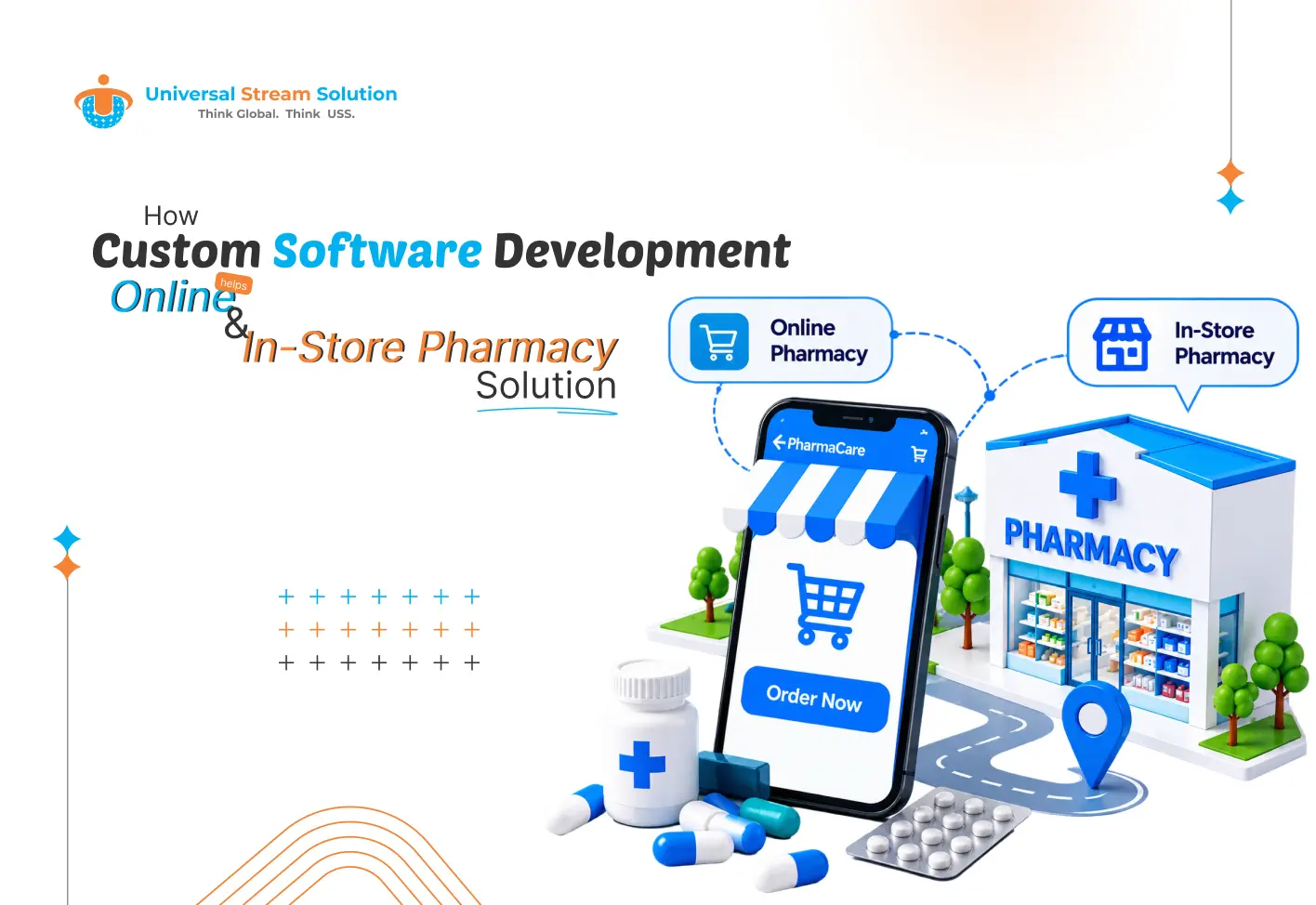
How Custom Software Development Helps Online and In-Store Pharmacy Solutions
Pharmacies are no longer limited to a traditional counter where patients hand over a prescription, wait for it to be filled, and return later to pick it up. Today, patients expect convenient digital services, faster communication, online refills, delivery options...

 29th October, 2026
 6 min read


Table Of Contents
- Introduction
- The Pressure Pharmacies Are Under
- Why Pharmacies Need More Than Basic Software
- Why Custom Software Beats Off-the-Shelf Solutions
- Unifying Online and In-Store Operations
- Connecting to the Wider Healthcare Ecosystem
- AI Is Making Pharmacy Work Smarter
- Healthcare CRM: Turning Customers into Long-Term Patients
- Security and Compliance Can't Be an Afterthought
- Choosing the Right Software Development Partner
- The Future of Online and In-Store Pharmacy Technology
Introduction
Pharmacies are no longer limited to a traditional counter where patients hand over a prescription, wait for it to be filled, and return later to pick it up. Today, patients expect convenient digital services, faster communication, online refills, delivery options, prescription reminders, and easy access to their medication information.
At the same time, pharmacy owners and operators need to manage inventory, prescriptions, billing, patient information, staff workflows, insurance processes, and customer relationships often across both physical and online channels.
This is where custom pharmacy software development can make a meaningful difference.
Instead of forcing a pharmacy to adapt its processes to a generic software platform, custom software can be designed around the pharmacy's actual workflow. It can connect online ordering with in-store operations, integrate healthcare systems, automate repetitive tasks and create a more consistent experience for patients and staff.
1. The Pressure Pharmacies Are Under
The numbers show why pharmacies need to think carefully about technology and efficiency.
According to the National Community Pharmacists Association (NCPA), thousands of personal pharmacies in the U.S. have closed over the past few years. Restitution pressure, rising costs and staffing shortages have all contributed to this challenge. At the same time, the U.S.A. e-pharmacy market continues to grow as more consumers become comfortable ordering prescriptions online.
Then there is the issue of data security.
The U.S. Department of Health and Human Services has reported that healthcare data breaches affecting 500 or more people have exceeded 700 incidents in recent years, with tens of millions of records exposed annually. IBM's Cost of a Data Breach report has also consistently ranked healthcare as the most expensive industry for data breaches, with average costs above $10 million per incident.
For a pharmacy handling prescriptions, insurance information, and patient histories, relying on generic tools with generic security can create unnecessary risks.
2. Why Pharmacies Need More Than Basic Software
A modern pharmacy may use several different systems at the same time, including pharmacy management software, point-of-sale systems(e-commerce), EHR/EMR based platforms, inventory tools, accounting, CRM systems, online ordering platforms and communication tools.
Having multiple systems isn't necessarily a real challenge begins when those systems don't communicate effectively and when problem-solving is required.
Staff may have to enter the same information more than once. Data can become inconsistent, processes can take longer, and employees may spend unnecessary time handling administrative work.
Custom Healthtech Solutions can help bring these workflows together.
For example: A patient could request a prescription refill through a pharmacy app. That request could then move directly into the pharmacy's workflow, where staff can review it, verify the necessary information, check inventory, process payment or insurance requirements, and prepare the order for pickup or delivery.
3. Why Custom Software Beats Off-the-Shelf Solutions
Packaged pharmacy systems are generally designed for the "average" pharmacy. But no pharmacy is the same.
A current independently owned pharmacy may have very different needs from a specialty compounding pharmacy. A regional chain with multiple locations and a delivery app may have completely different workflows.
Custom software gives pharmacies the flexibility to build technology around the way their business operates.
With custom development, pharmacies can:
- Match their workflow: Instead of forcing staff to adapt to rigid screens and processes, the software can be designed around their existing workflow.
- Connect every channel: Online orders, in-store pickups, and deliveries can be synchronised in real time.
- Own their roadmap: Pharmacies can add features when they need them instead of waiting for a software vendor's development schedule.
- Scale without re-platforming: The system can grow with the business, from one location to fifty.
4. Unifying Online and In-Store Operations
For hybrid pharmacies, fragmentation can become one of the biggest operational headaches.
For example, a website may show that a medication is in stock while the store has different inventory information. A patient may submit a request online, but the pharmacist may not see it in time.
Custom software can help solve these problems by creating a single system of record.
Inventory, orders, prescriptions, and customer profiles can be managed in one place, regardless of whether a request comes through an app, phone call, or front counter.
Staff can work with the same information patients see, reducing errors, unnecessary calls, and communication gaps.
Features that can make a real difference include:
- Automated refill reminders
- E-prescription intake
- Barcode-based dispensing checks
- Curbside pickup scheduling
- Delivery scheduling
- Real-time insurance eligibility verification
These features can help connect the different parts of the pharmacy experience instead of treating online and in-store operations as separate processes.
5. Connecting to the Wider Healthcare Ecosystem
Pharmacies don't operate in isolation.
Pharmacists need medication histories from prescribers, while prescribers can benefit from knowing whether patients fill their prescriptions.
This is where EHR software development and EMR software development can play an important role.
Using healthcare standards such as HL7 and FHIR, custom integrations can pull in information such as allergy lists, diagnoses, and lab values and then send back dispensing records.
The benefit can extend beyond operational efficiency. Better information flow can help pharmacists identify potentially dangerous interactions earlier and support medication therapy management.
Medication non-adherence is another important concern. According to the CDC, medication non-adherence contributes to roughly 125,000 preventable deaths in the U.S. each year and billions of dollars in avoidable healthcare costs.
Better data flow between pharmacies and providers is one practical way to help address this challenge.
6. AI Is Making Pharmacy Work Smarter
AI-implemented software is not about replacing pharmacists. Instead, it can give pharmacy teams more time by reducing repetitive work and supporting everyday workflows.
Practical AI use cases can include:
- Demand forecasting: Helping reduce overstock and stockouts, especially for temperature-sensitive or high-cost drugs.
- Prescription workflow automation: Helping read handwritten or faxed prescriptions and flag potential errors.
- Adherence prediction: Identifying patients who may be likely to skip refills so pharmacy staff can reach out earlier.
- Chatbots and virtual assistants: Handling routine questions about store hours, refill status, pickup times, and similar requests.
When these tools are built around a pharmacy's own data and processes, they can be more useful and accurate than generic add-ons.
7. Healthcare CRM: Turning Customers into Long-Term Patients
Pharmacies are common healthcare touchpoints that patients visit most frequently. Because of this, maintaining strong patient relationships can be a valuable part of the business.
Healthcare CRM development gives pharmacies a better way to manage patient relationships and stay connected.
A custom CRM can help pharmacies understand patient preferences, send timely vaccine and refill reminders, manage loyalty programs and provide more personalized communication for patients with ongoing care needs, while keeping privacy requirements in mind.
This can help pharmacies build stronger patient relationships and support better outcomes. For example, a simple, timely reminder can help a patient remember to refill a prescription or stay on track with their treatment plan.
8. Security and Compliance Can't Be an Afterthought
Any pharmacy that handles protected health information (PHI) needs to follow HIPAA requirements. HIPAA-compliant software development means building security and privacy safeguards into the software from the start, rather than trying to add them later.
These safeguards can include:
- Role-based access
- End-to-end encryption
- Audit trails
- Secure cloud hosting
- Breach-response procedures
Pharmacies also need to consider other requirements, such as state regulations, DEA rules for controlled substances, EPCS requirements, and payer-specific guidelines.
An experienced Healthcare Software Company USA can help navigate these requirements and build software that fits the pharmacy's specific needs.
9. Choosing the Right Software Development Partner
Not every software development company understands the specific needs of the pharmacy industry. Choosing the right technology partner can make a big difference when building or improving a pharmacy solution.
When evaluating a development partner, look for a company with:
- Proven Healthtech Solutions experience and relevant healthcare case studies.
- A strong understanding of HIPAA, HL7/FHIR, and e-prescribing standards.
- A phased development approach that can start with an MVP and deliver value early.
- Ongoing support, security updates, and system monitoring.
- Clear pricing and ownership of the software and source code.
It's also a good idea to ask for client references and understand how the company handles audits, integrations, and data migration.
These conversations can help you determine whether the development partner truly understands the day-to-day challenges of pharmacy technology and can build a solution around your business needs.
The Future of Online and In-Store Pharmacy Technology
The pharmacy experience is becoming more connected every day.
A patient might start by using their phone to request a prescription refill, communicate with the pharmacy online, receive an electronic prescription from their healthcare provider, and then choose to pick up the medication in-store or have it delivered to their home.
For the patient, the entire process should feel simple and connected.
Behind that simple experience, however, several different systems and processes need to work together smoothly.
For pharmacies across the United States, going digital isn't just about adding more technology. It's about connecting patients, pharmacists, healthcare providers, inventory, payments, communication, and daily business operations in a way that works for everyone.
A specialized Healthcare Software Development Company can help pharmacies review their current workflows, identify technology gaps, connect existing systems, and build solutions around their specific business needs.
The best pharmacy software isn't necessarily the one with the most features.
It's the software that makes everyday pharmacy work easier, safer, and more connected.
If your pharmacy is managing separate systems for online orders, in-store operations, patient communication, inventory, and healthcare data, custom software can help bring these processes together and create a smoother experience for both your team and your patients.

Raj Shah

Raj Shah is a seasoned full-stack developer and technology leader specializing in Android, iOS and cross-platform solutions such as React Native and Kotlin. With extensive hands-on experience architecting next-gen mobile applications, Raj drives innovation, user-centric design and scalable digital platforms.
Related Blogs





 +91 9638225549
 sales@universalstreamsolution.com


