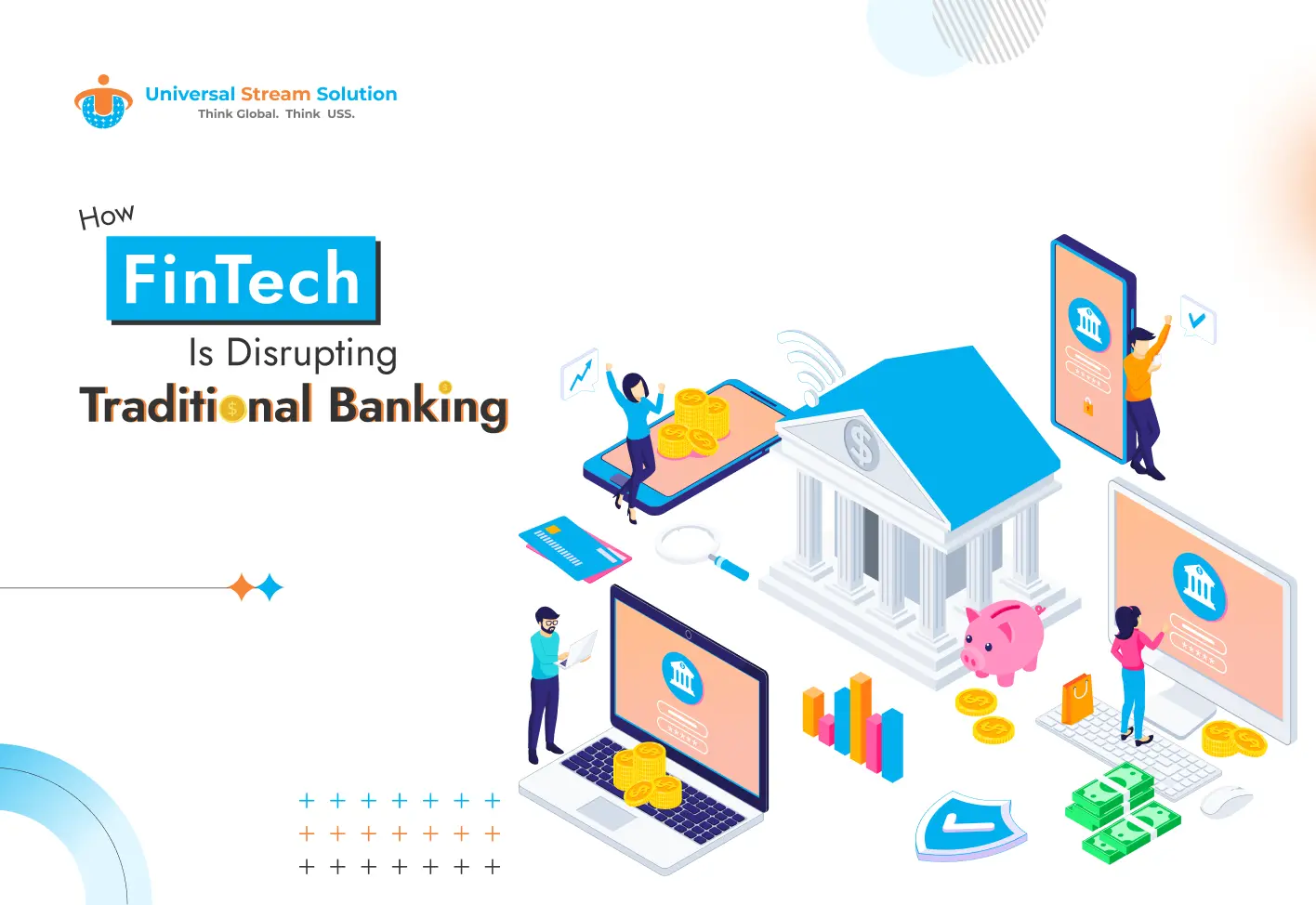
How FinTech Is Disrupting Traditional Banking

 12th May, 2026
 6 min read


Table Of Contents
- Introduction
- What Is FinTech?
- The Rise of Digital Banking
- Faster and More Convenient Payments
- AI and Automation in Financial Services
- FinTech Is Improving Financial Inclusion
- Blockchain and Cryptocurrency Are Challenging Traditional Banking
- Personalized Customer Experiences
- Lower Costs and Reduced Banking Fees
- The Impact on Small Businesses and Startups
- Open Banking and API Integration
- Cybersecurity and Data Protection Challenges
- Regulatory Challenges in the FinTech Industry
- How Traditional Banks Are Responding
- The Future of FinTech and Banking
- Conclusion
Introduction
The financial industry is experiencing one of the biggest transformations in modern business history. Traditional banking systems that once relied heavily on physical branches, paperwork, and lengthy approval processes are now being challenged by fast, digital-first financial technology solutions. This shift is being driven by the rapid growth of FinTech.
FinTech, short for financial technology, is redefining how individuals and businesses manage money, make payments, apply for loans, invest, and access financial services. From mobile banking apps and AI-driven financial platforms to blockchain technology and digital wallets, FinTech companies are creating faster, smarter, and more accessible alternatives to traditional banking methods.
Customers today expect convenience, speed, personalization, and seamless digital experiences. Traditional banks are no longer competing only with other banks—they are now competing with technology-driven platforms that prioritize innovation and customer experience.
As digital transformation accelerates across industries, FinTech continues to reshape the future of banking. Understanding how FinTech is disrupting traditional banking is essential for businesses, financial institutions, startups, and consumers looking to adapt to this evolving financial landscape.
1. What Is FinTech?
FinTech refers to the use of technology to improve and automate financial services. It combines finance and innovation to simplify processes, reduce costs, and enhance customer experiences.
FinTech solutions include:
- Mobile banking applications
- Digital payment systems
- Peer-to-peer lending platforms
- Cryptocurrency and blockchain solutions
- Robo-advisors
- Buy Now Pay Later (BNPL) services
- AI-powered financial tools
- Online investment platforms
- InsurTech and RegTech solutions
Unlike traditional banking systems that often depend on legacy infrastructure, FinTech companies are built with digital-first strategies, allowing them to innovate faster, integrate AI in property financing, and deliver more flexible and customer-centric financial services.
2. The Rise of Digital Banking
One of the biggest ways FinTech is disrupting traditional banking is through digital banking platforms.
Consumers no longer want to visit physical branches for routine banking activities. They expect instant access to banking services directly from their smartphones or laptops.
Digital banks and neo-banks offer:
- Online account opening
- Instant money transfers
- Real-time transaction tracking
- Mobile-first banking experiences
- Automated savings tools
- Budget management features
- Lower transaction fees
This shift toward digital banking has forced traditional banks to modernize their systems and invest heavily in technology infrastructure.
Banks that fail to adapt risk losing customers to more agile FinTech competitors.
3. Faster and More Convenient Payments
Traditional banking systems often involve delays, especially for international transactions and cross-border payments. FinTech companies are solving this problem by creating faster and more efficient payment solutions.
Digital payment platforms and mobile wallets allow users to:
- Transfer money instantly
- Pay bills online
- Make contactless payments
- Send international payments with lower fees
- Manage transactions in real time
The growing popularity of cashless transactions is changing customer expectations. Users now prioritize convenience and speed over traditional banking methods.
Payment innovation has become one of the strongest drivers of FinTech growth worldwide.
4. AI and Automation in Financial Services
Artificial Intelligence (AI) is playing a major role in the FinTech revolution.
Traditional banks often rely on manual processes for customer support, fraud detection, loan approvals, and risk assessments. FinTech companies are using AI, automation, and secure banking technology solutions to improve efficiency, strengthen data security, and reduce operational costs.
AI-powered financial systems can:
- Detect fraudulent transactions instantly
- Analyze customer spending patterns
- Automate customer support with chatbots
- Provide personalized financial recommendations
- Speed up loan approval processes
- Improve risk management
Automation allows financial institutions to deliver faster and more accurate services while improving customer satisfaction.
As AI technology continues to evolve, financial services are becoming more intelligent, predictive, and customer-focused.
5. FinTech Is Improving Financial Inclusion
One of the most impactful aspects of FinTech is its ability to improve financial inclusion.
Millions of people worldwide still lack access to traditional banking services due to geographic, economic, or documentation barriers. FinTech platforms are helping bridge this gap by providing digital financial solutions accessible through smartphones and internet connectivity.
FinTech enables underserved populations to:
- Open digital accounts remotely
- Access microloans
- Make mobile payments
- Build credit histories
- Use digital wallets without traditional bank accounts
This accessibility is helping individuals and small businesses participate more actively in the global economy.
Financial inclusion is especially important in emerging markets, where mobile technology adoption is growing rapidly.
6. Blockchain and Cryptocurrency Are Challenging Traditional Banking
Blockchain technology and cryptocurrencies are creating entirely new financial ecosystems outside conventional banking systems.
Blockchain offers:
- Decentralized financial transactions
- Enhanced security
- Greater transparency
- Reduced transaction costs
- Faster international payments
Cryptocurrencies such as Bitcoin and Ethereum have introduced alternative methods of storing and transferring value.
While traditional banks remain cautious about cryptocurrency adoption, many financial institutions are now exploring blockchain technology to improve security, streamline operations, and reduce fraud.
Decentralized Finance (DeFi) platforms are also expanding rapidly, allowing users to lend, borrow, and trade assets without relying on traditional banks.
This technological shift is pushing banks to rethink their role in the future financial ecosystem.
7. Personalized Customer Experiences
Modern customers expect personalized experiences from every digital platform they use, including financial services.
Traditional banking systems often struggle to deliver customized experiences because of outdated infrastructure and fragmented customer data.
FinTech companies use advanced analytics and AI to provide:
- Personalized investment recommendations
- Spending insights
- Smart budgeting tools
- Customized loan offers
- Financial planning assistance
By leveraging customer data effectively, FinTech platforms can create highly tailored user experiences that improve engagement and loyalty.
Customer-centric innovation has become a major competitive advantage in the financial industry.
8. Lower Costs and Reduced Banking Fees
Traditional banks typically operate large physical branch networks and complex operational systems, which contribute to higher service costs.
FinTech companies operate with leaner digital infrastructures, allowing them to reduce overhead expenses and offer more affordable financial services.
Benefits for customers include:
- Lower transaction fees
- Reduced loan processing costs
- No minimum balance requirements
- Affordable international transfers
- Competitive interest rates
This cost efficiency is attracting consumers and businesses looking for more flexible financial solutions.
As price-sensitive customers shift toward digital financial platforms, traditional banks are under pressure to rethink their fee structures and operational models.
9. The Impact on Small Businesses and Startups
FinTech is not only transforming consumer banking but also creating new opportunities for businesses and startups.
Small businesses often face challenges when accessing traditional financial services due to strict eligibility requirements and slow approval processes.
FinTech solutions provide businesses with:
- Faster business loans
- Digital invoicing systems
- Automated accounting tools
- Online payment gateways
- Expense management platforms
- Real-time financial analytics
These technologies help businesses improve operational efficiency, manage cash flow more effectively, and scale faster.
Startups, especially in eCommerce and digital services, increasingly rely on FinTech solutions for seamless financial operations.
10. Open Banking and API Integration
Open banking is another major innovation disrupting traditional banking systems.
Open banking allows third-party financial service providers to access banking data securely through APIs (Application Programming Interfaces).
This creates opportunities for:
- Better financial transparency
- Integrated financial applications
- Personalized banking experiences
- Faster financial services innovation
Customers benefit from having multiple financial services connected within a single digital ecosystem.
Traditional banks are now partnering with FinTech companies instead of viewing them solely as competitors. Collaboration between banks and FinTech firms is becoming a common strategy for driving innovation.
11. Cybersecurity and Data Protection Challenges
As financial services become increasingly digital, cybersecurity has become a critical concern.
FinTech companies handle large volumes of sensitive financial data, making security a top priority.
Key cybersecurity measures include:
- Multi-factor authentication
- AI-based fraud detection
- End-to-end encryption
- Biometric verification
- Real-time transaction monitoring
Traditional banks and FinTech companies alike must continuously invest in cybersecurity technologies to protect customer trust and comply with regulatory requirements.
Data privacy and security will remain major factors influencing the future of digital finance.
12. Regulatory Challenges in the FinTech Industry
Despite its rapid growth, FinTech also faces regulatory challenges.
Governments and financial authorities must balance innovation with consumer protection and financial stability.
Common regulatory concerns include:
- Data privacy compliance
- Anti-money laundering (AML)
- Fraud prevention
- Cryptocurrency regulation
- Digital identity verification
- Cross-border transaction compliance
As the industry evolves, regulatory frameworks are also adapting to support innovation while maintaining security and transparency
FinTech companies that successfully navigate regulatory environments are more likely to achieve long-term growth and market trust.
13. How Traditional Banks Are Responding
Traditional banks are not disappearing—they are evolving.
To stay competitive, many banks are:
- Investing in digital transformation
- Launching mobile banking solutions
- Partnering with FinTech startups
- Implementing AI technologies
- Modernizing legacy systems
- Improving customer experiences
Some banks are even creating their own digital-only banking divisions to compete directly with neo-banks.
The future of banking will likely involve collaboration between traditional financial institutions and innovative FinTech companies.
14. The Future of FinTech and Banking
The disruption caused by FinTech is far from over.
Emerging technologies such as:
- Artificial Intelligence
- Machine Learning
- Blockchain
- Embedded Finance
- Decentralized Finance (DeFi)
- Quantum Computing
- Digital Identity Systems
will continue transforming financial services in the coming years.
Future banking experiences are expected to become:
- More personalized
- Fully digital
- Highly secure
- Data-driven
- Faster and more accessible
Consumers and businesses will increasingly choose financial platforms that prioritize convenience, transparency, and innovation.
Financial institutions that embrace digital transformation will be better positioned for long-term success.
Conclusion
FinTech is fundamentally reshaping the traditional banking industry by introducing faster, smarter, and more customer-centric financial solutions.
From digital payments and AI-powered services to blockchain technology and financial inclusion, FinTech innovation is changing how people interact with money and financial institutions.
Traditional banks are being challenged to modernize, improve customer experiences, and adopt new technologies to remain competitive in an increasingly digital world. Businesses are also increasingly seeking fintech software consultation to build scalable, secure, and future-ready financial platforms.
As technology continues to evolve, the relationship between FinTech and traditional banking will continue to redefine the future of global finance. Businesses that understand and adapt to these changes will be better prepared to succeed in the rapidly evolving financial ecosystem.
Jignesh Vaghasiya

Jignesh Vaghasiya is a visionary tech entrepreneur and CEO with over 15 years of experience in driving digital transformation and business growth. He specializes in AI, mobile app innovation, and scalable tech strategies that empower global enterprises.
Related Blogs





 +91 9638225549
 sales@universalstreamsolution.com


