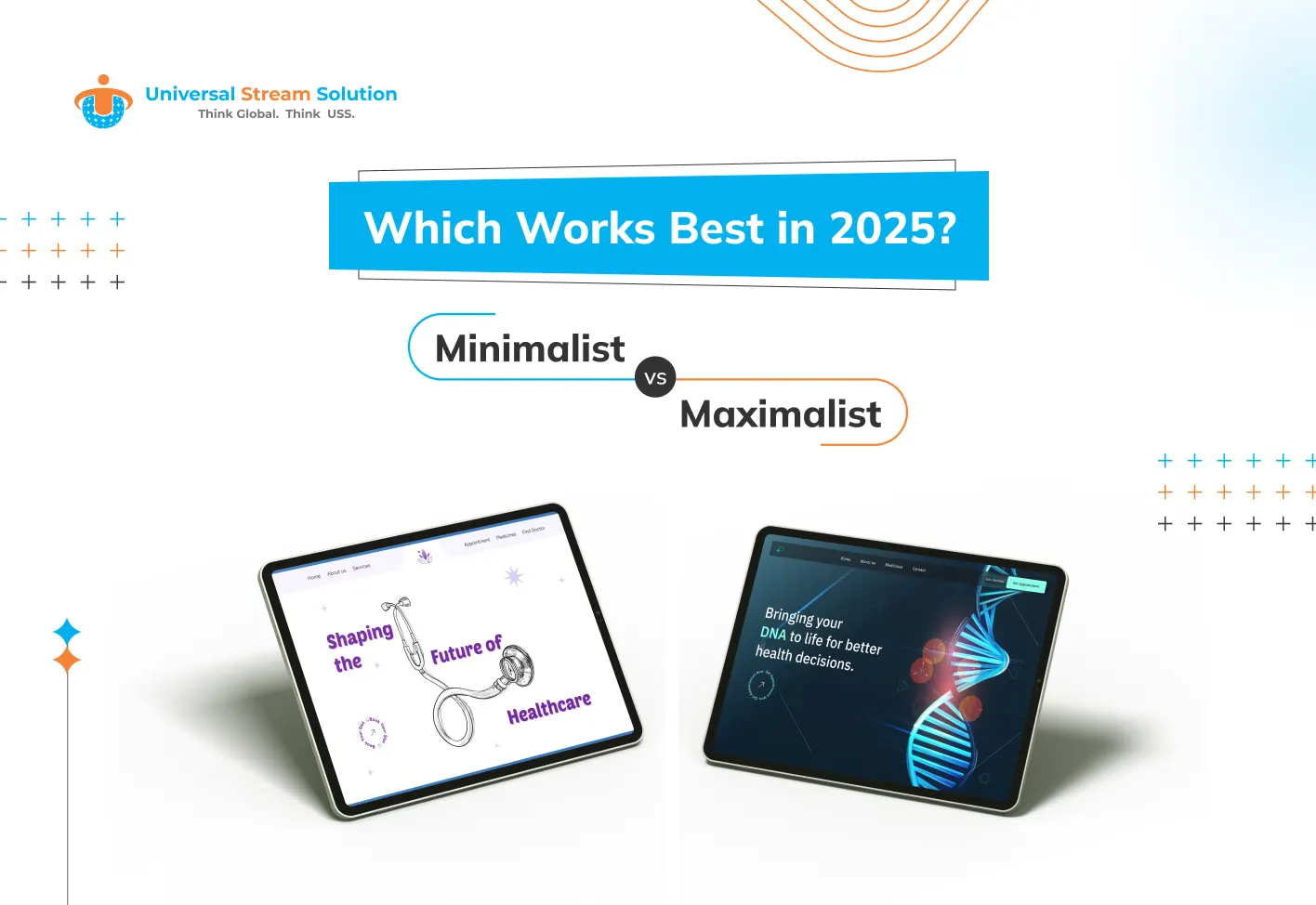
Minimalist vs Maximalist Branding: Which Works Best in 2025?

 16th December, 2025
 6 min read


Table Of Contents
- Introduction
- Understanding Minimalist Branding in Today’s Context
- What Maximalist Branding Really Means
- Why This Choice Matters More in 2025 Than Before
- The Real Difference: User Intent
- Where Minimalist Branding Performs Best
- Where Maximalist Branding Has the Advantage
- Strengths and Limitations of Minimalist Branding
- Strengths and Limitations of Maximalist Branding
- The Reality in 2025: Most Strong Brands Are Hybrid
- Execution Is More Important Than Style
- Branding Trends Influencing 2025 Decisions
- Final Perspective: What Actually Works in 2025
Introduction
Branding conversations in 2025 look very different from even a few years ago. Today, it’s no longer just about logos, colors, or visual trends. It’s about how quickly users understand you, how confidently they trust you, and how strongly they remember you.
This is why the debate between minimalist and maximalist branding keeps resurfacing.
Some brands are stripping everything down—clean interfaces, quiet colors, almost invisible design. Others are going in the opposite direction, leaning into bold visuals, expressive layouts, and unmistakable personality.
So which approach actually works in 2025? opposite direction, leaning into bold visuals, expressive layouts, and unmistakable personality.
The answer isn’t as simple as choosing one side. It depends on user intent, industry expectations, and how people interact with your brand in real life. Let’s break it down properly.
1. Understanding Minimalist Branding in Today’s Context
Minimalist branding is often misunderstood as “basic” or “plain.” In reality, it’s one of the hardest design approaches to execute well.
At its core, minimalism is about removing friction. Every element must justify its presence. If it doesn’t help the user understand, navigate, or decide—it’s gone.
In practical terms, minimalist branding usually includes:
- Clear layouts with breathing room
- Limited and intentional color use
- Typography that prioritizes readability
- Simple visual hierarchy
- Strong focus on function over decoration
In 2025, minimalism has become closely tied to trust. Users subconsciously associate clean, uncluttered interfaces with reliability—especially in industries where accuracy and confidence matter.
2. What Maximalist Branding Really Means
Maximalist branding isn’t chaos for the sake of attention. At its best, it’s controlled expression.
This approach embraces richness—layered visuals, strong contrast, expressive typography, illustration, motion, and storytelling. It doesn’t try to disappear into the background. It wants to be seen, felt, and remembered.
Maximalist branding often works when:
- The brand competes in a crowded visual space
- Emotional connection matters more than speed
- Identity and culture are part of the product
In 2025, maximalism has matured. It’s less about being loud and more about being distinct.
3. Why This Choice Matters More in 2025 Than Before
Design decisions now directly affect business outcomes.
Users today:
- Decide whether to trust a brand in seconds
- Abandon confusing interfaces instantly
- Expect seamless experiences across devices
At the same time, competition has exploded. Almost every industry is digitally crowded. Branding isn’t decoration anymore—it’s navigation.
Minimalist and maximalist branding succeed or fail based on how well they support what users are actually trying to do.
4. The Real Difference: User Intent
The most important factor isn’t aesthetics. It’s intent.
When someone lands on your website or app, they usually fall into one of two mindsets:
- Task-focused – “I need to do something quickly.”
- Exploration-focused – “I want to experience or discover something.”
Minimalist branding supports the first.
Maximalist branding supports the second.
5. Where Minimalist Branding Performs Best
Minimalist branding shines in situations where clarity isn’t optional—it’s essential.
Think about users searching for:
- Healthcare platforms
- Financial services
- Productivity tools
- Enterprise or B2B solutions
In these cases, users don’t want to explore. They want reassurance and efficiency.
A good example of this approach can be seen in a user-centric medicine delivery app design case study focused on safety and reliability. The interface relies on calm colors, clear structure, and intuitive flows—allowing users to place orders or access information without hesitation.
This kind of design works because it aligns with the user’s mindset. When people search for safe medicine delivery UX or healthcare app UI design , they’re prioritizing trust over flair. 👇
6. Where Maximalist Branding Has the Advantage
Maximalist branding performs best when brands need to create a feeling, not just enable an action.
This is common in:
- Fashion and lifestyle brands
- Media and entertainment platforms
- Creative products
- Youth-focused consumer brands
Here, users often arrive with curiosity. They expect personality. A visually rich experience feels intentional, not distracting.
In these cases, minimalism can feel empty—while maximalism feels alive.
7. Strengths and Limitations of Minimalist Branding
Strengths
- Faster comprehension
- Lower cognitive load
- Easier scalability across platforms
- Feels modern and professional
- Strong for conversion-focused experiences
Limitations
- Can feel generic without strong content
- Less emotional impact
- Harder to stand out visually
Minimalism only works when the underlying structure is excellent. Poor content or weak hierarchy becomes very obvious.
8. Strengths and Limitations of Maximalist Branding
Strengths
- High memorability
- Strong emotional resonance
- Encourages exploration
- Distinct brand personality
Limitations
- Can overwhelm users
- Risk of inconsistency
- Requires strong design governance
Maximalism fails when it ignores usability. Visual excitement should never come at the cost of clarity.
9. The Reality in 2025: Most Strong Brands Are Hybrid
The most successful brands today aren’t choosing sides. They’re blending approaches.
You’ll often see:
- Clean navigation and structure
- Expressive visuals in hero sections
- Minimal layouts supported by bold storytelling moments
This hybrid approach respects user time while still delivering personality.
It’s especially effective for brands that operate across multiple touchpoints—websites, apps, dashboards, and marketing campaigns.
10. Execution Is More Important Than Style
Choosing minimalism or maximalism is only the starting point. What actually matters is how well the design is executed.
Brands often struggle not because they chose the wrong style, but because visuals weren’t aligned with user behavior. That’s where professional graphic design and UI UX services become critical.
A strong design team doesn’t just make things look good. They translate business goals and user intent into usable systems—ensuring branding remains consistent, accessible, and scalable as the product grows.
For companies looking to balance visual identity with real usability, investing in graphic design and UI UX services for modern brands helps bridge the gap between aesthetics and performance. 👇
graphic design and UI UX services for modern brands
11. Branding Trends Influencing 2025 Decisions
A few shifts are shaping how brands approach this choice:
- AI-driven personalization: Interfaces adapt visually based on user behavior
- Motion and interaction: Subtle animation adds personality without clutter
- Accessibility-first design: Both styles must meet inclusivity standards
- Intent-based experiences: Design responds to what users need, not trends
These trends favor thoughtful design over extreme stylistic choices.
12. Final Perspective: What Actually Works in 2025
Minimalist branding works when users need confidence, speed, and clarity. Maximalist branding works when users seek emotion, identity, and immersion.
But the strongest brands in 2025 focus less on labels and more on alignment—between design, intent, and experience.
If your branding helps users understand you quickly, trust you easily, and remember you clearly, you’re already doing it right.
That’s what wins—not minimalism or maximalism alone.
Nirav Mehta

Nirav Mehta is an innovative UI/UX Designer with a passion for crafting user-friendly and visually compelling digital experiences. Skilled in user research, interface design, and product usability, he focuses on creating designs that balance creativity with functionality. Nirav’s design philosophy centers on empathy, simplicity, and seamless user interaction.
Related Blogs


 +91 9638225549
 sales@universalstreamsolution.com


