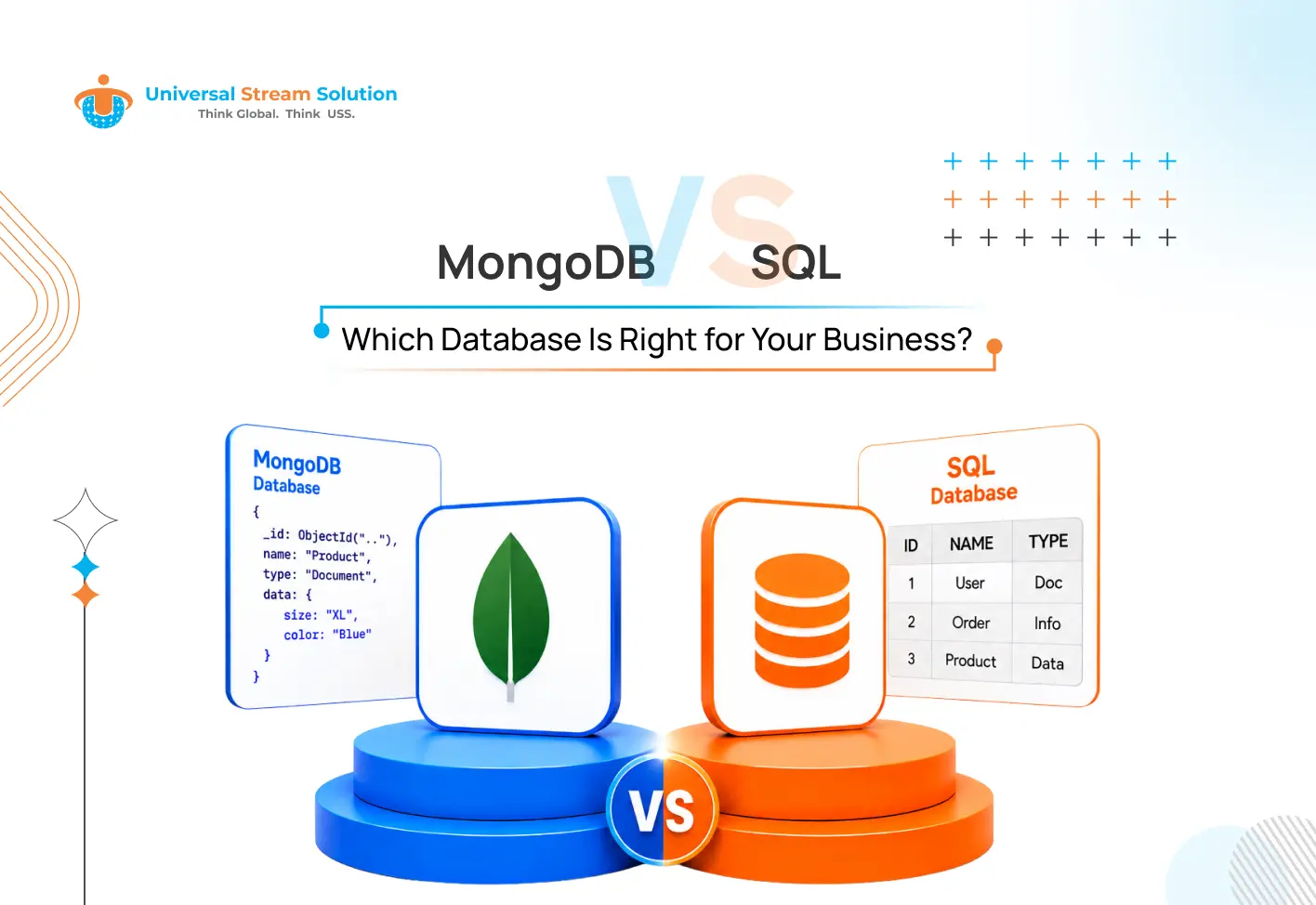
MongoDB vs SQL: Which Database Is Right for Your Business?

 29th September, 2026
 6 min read


Table Of Contents
- Introduction
- What Is MongoDB?
- What Is an SQL Database?
- MongoDB vs SQL: Key Differences
- When Should You Choose MongoDB?
- When Should You Choose SQL?
- MongoDB vs SQL for Healthcare Applications
- What About AI and Modern Applications?
- How to Choose the Right Database
- Conclusion
Introduction
Choosing the right database is an important decision for any business building a new application or modernising an existing system. The database you select can affect application performance, scalability, development speed, data management, and long-term maintenance.
The two most popular options are MongoDB and SQL databases such as MySQL, PostgreSQL, and Microsoft SQL Server. MongoDB uses a document-based NoSQL model, while SQL databases use a structured relational model.
So, which one is right for your needs? The answer depends on your data, application requirements, growth plans, and development priorities.
1. What Is MongoDB?
MongoDB is a NoSQL database that stores information in flexible, JSON-like documents. Unlike traditional relational databases, MongoDB does not require every record to follow the same fixed structure.
Use this flexibility when applications need to handle changing data or develop features quickly.
Key Advantages of MongoDB:
- Flexible Data Structure: Developers can modify document structures as application requirements change.
- Scalability: MongoDB supports horizontal scaling, making it suitable for applications expecting significant data growth.
- Fast Development: Its document-oriented structure can simplify development for certain applications.
- Large Data Handling: MongoDB can work well with high volumes of semi-structured or unstructured data.
For Example: MongoDB can be considered for applications involving product catalogs, content platforms, real-time applications, and systems where data structures frequently evolve.
2. What Is an SQL Database?
SQL databases organise data into tables containing rows and columns. Relationships between different types of information are managed using keys and SQL queries.
Popular SQL databases include MySQL, PostgreSQL, Oracle Database, and Microsoft SQL Server.
Key Advantages of SQL Databases:
- Structured Data: Tables provide a clearly defined structure for storing information.
- Strong Relationships: SQL is well suited to applications where multiple data entities are closely connected.
- Data Consistency: Transactions and constraints help maintain reliable and accurate data.
- Mature Ecosystem: SQL databases have been used extensively across industries and business applications.
For applications such as financial systems, enterprise platforms, inventory management, and many CRM systems, a relational database can provide a strong foundation.
3. MongoDB vs SQL: Key Differences
MongoDB
Data Model: Document-based
Schema: Flexible
Relationships: Usually embedded or application-managed
Scalability: Strong horizontal scaling capabilities
Transactions: Supports transactions
Best Suited For: Flexible and evolving data
Query Language: MongoDB Query API
Data Consistency: Flexible depending on design
Development: Can be faster for changing requirements
Typical Use Cases: Content, real-time apps, flexible data
SQL Database
Data Model: Relational tables
Schema: Structured and predefined
Relationships: Strong support through relationships and joins
Scalability: Traditionally vertical, with horizontal options depending on the database
Transactions: Strong transaction support
Best Suited For: Structured and relational data
Query Language: SQL
Data Consistency: Strong consistency and constraints
Development: Often requires more schema planning
Typical Use Cases: Finance, ERP, CRM, transactional systems
Note: The table provides a general comparison, but neither database is universally better. The right choice depends on the specific application.
4. When Should You Choose MongoDB?
MongoDB may be a suitable option when your application deals with rapidly changing or semi-structured data.
For Example: A startup developing a new platform may not have a completely finalised data model. MongoDB's flexible document structure can allow developers to adapt the database as features evolve.
It can also be useful for:
- Real-Time Applications: Suitable for applications that process continuously changing information.
- Large-Scale Platforms: Horizontal scaling can support applications experiencing substantial growth.
- Flexible Content: Useful when different records may contain different attributes.
- Rapid Product Development: A flexible schema can reduce the need for frequent database structure changes.
MongoDB can therefore be considered during Web Development projects where flexibility and scalability are important requirements.
5. When Should You Choose SQL?
SQL is often a strong choice when your business depends on structured information, complex relationships, and reliable transactions.
For Example: A CRM may need to connect customers, sales representatives, invoices, products, and payments. A relational database can represent these relationships clearly and enforce rules around the data.
SQL can be particularly suitable for:
- Financial Applications: Transactions require accuracy and consistency.
- CRM Platforms: Customer, sales, and account data often have well-defined relationships.
- Enterprise Applications: Structured business processes can benefit from relational data models.
- Reporting Systems: SQL provides powerful tools for querying and analysing related data.
This makes SQL a common consideration for CRM Development, enterprise applications, and systems that require detailed reporting.
6. MongoDB vs SQL for Healthcare Applications
Healthcare applications require careful consideration because they may manage complex and sensitive information. Systems involved in Healthcare Software Development and Medical Software Development can contain patient records, appointments, billing information, clinical data, and other interconnected information.
A relational database may be useful when strong relationships, transactions, and structured records are central to the application. MongoDB may be considered when the application needs to manage flexible clinical or operational data structures.
The important point is that database selection should be based on the application's architecture, security requirements, compliance obligations, scalability needs, and data model, not simply on popularity.
7. What About AI and Modern Applications?
Modern AI Development projects can generate and process different types of data, including user interactions, logs, metadata, documents, and model-related information.
MongoDB can be useful for flexible application data, while SQL can be valuable when AI systems depend on structured business records and transactional information.
In some architectures, businesses may use both databases. For example, SQL could manage core transactional information while MongoDB handles flexible application data.
8. How to Choose the Right Database
Before making a decision, consider these factors:
- Data Structure: Determine whether your data is primarily structured or frequently changing.
- Relationships: Identify how strongly different data entities depend on one another.
- Scalability: Consider expected data volume, traffic, and future growth.
- Transactions: Evaluate whether your application requires strict transactional consistency.
- Development Requirements: Consider how quickly your team needs to introduce and modify features.
- Long-Term Maintenance: Think about database expertise, infrastructure, monitoring, and operational costs.
Conclusion
There is no single winner in the MongoDB vs SQL comparison. MongoDB offers flexibility and scalability for applications with evolving or semi-structured data, while SQL databases provide a structured approach with strong relationships, transactions, and data consistency.
For projects such as Digital Healthcare Solutions, Web Development, CRM platforms, or AI-powered applications, the best database depends on the application's specific requirements.
If you're unsure which database architecture fits your project, consulting with an experienced development team can help you evaluate your data model, scalability requirements, security needs, and long-term goals before development begins.

Bharat Katariya

Bharat Katariya is a seasoned executive at Universal Stream Solution LLC, bringing a strong track record of leadership and commercial strategy. With robust experience in driving business growth and operational transformation, he empowers organizations to build scalable, efficient solutions. Bharat is committed to delivering strategic value through innovation, collaboration, and integrity.
Related Blogs



 +91 9638225549
 sales@universalstreamsolution.com


