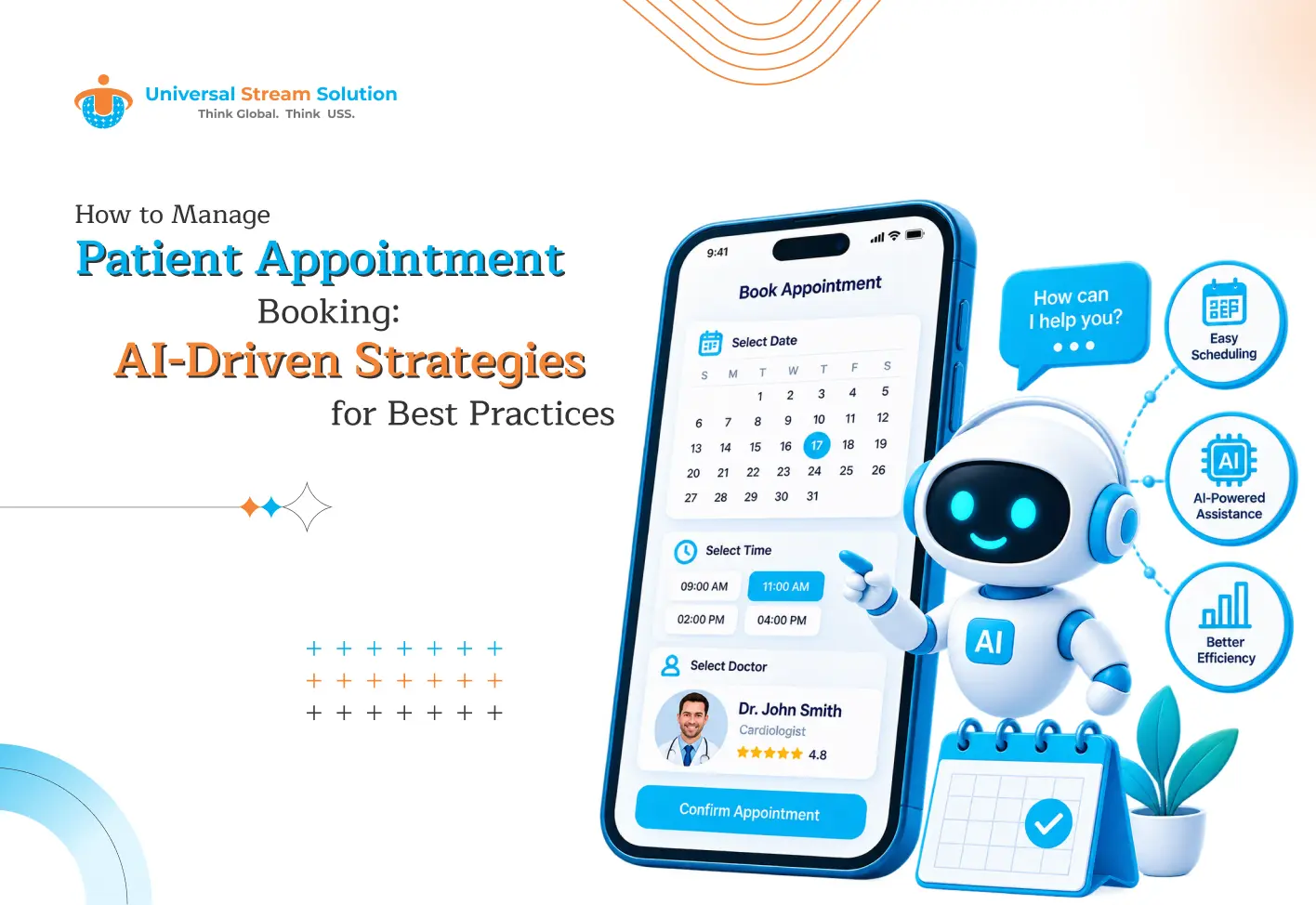
How to Manage Patient Appointment Booking: AI-Driven Strategies for Best Practices

 5th October, 2026
 6 min read


Table Of Contents
- Introduction
- Why Patient Appointment Management Matters
- What Should Healthcare Practices Consider Before Implementing AI?
- The Future of Patient Appointment Booking
- Improve Your Healthcare Appointment Workflow
Introduction
"AI is changing work patterns across industries, and its impact is being felt worldwide."
Managing patient appointments sounds simple, but for many healthcare practices, it can become one of the most time-consuming parts of daily operations. Phone calls, cancellations, rescheduling requests, missed appointments, reminder messages, and last-minute schedule changes can quickly create extra work for front-desk teams.
For medical practices in the United States and Canada, improving the appointment process is not only about filling the calendar. It is also about making healthcare easier to access and creating a smoother experience for patients and staff.
Modern Patient Appointment Booking solutions are changing how practices handle this process. Online scheduling, automated reminders, patient portals, and artificial intelligence (AI) can help reduce repetitive administrative work while keeping patients informed throughout the appointment journey.
Research has consistently found that appointment reminders can improve attendance. One systematic review found that patients receiving electronic notifications were more likely to attend appointments and less likely to miss them, with multiple notifications showing additional benefit in the studies reviewed.
AI adds another opportunity: instead of treating every appointment in exactly the same way, healthcare organizations can use data and automation to identify patterns and support more personalized scheduling workflows.
1. Why Patient Appointment Management Matters
A missed appointment can affect more than a single time slot. When a patient does not attend and does not cancel in advance, the practice may have limited opportunity to offer that appointment to someone else.
For patients, missed appointments can also mean delays in follow-up care or preventive services. For healthcare staff, frequent cancellations and no-shows can create an unpredictable schedule and additional administrative work.
A systematic review of appointment scheduling research identified factors such as longer waiting periods before an appointment and previous no-show history as commonly associated with missed appointments.
This is why an effective appointment strategy should look at the entire process, from booking to confirmation, reminders, rescheduling, and follow-up.
a. Make Patient Appointment Booking Easy
The first step is to make scheduling convenient.
Patients increasingly expect to be able to interact with businesses online, and healthcare scheduling is no exception. An online Patient Appointment Booking system can allow patients to request or schedule available appointments without always needing to call the office.
Depending on the practice and technology platform, patients may be able to:
- View available appointment times
- Request an appointment online
- Select a provider or appointment type
- Receive confirmation
- Cancel or reschedule
- Complete selected information before the visit
A simpler scheduling experience can reduce unnecessary back-and-forth communication and give front-desk staff more time for tasks that require personal attention.
b. Use an Appointment Scheduling App for Better Organization
An Appointment Scheduling App can help connect patients, providers, and administrative teams through one scheduling workflow.
Rather than maintaining appointment information across multiple systems, practices can use scheduling technology to organize calendars, appointment types, provider availability, and patient requests.
For larger practices, this can become particularly useful when multiple providers, locations, or specialties are involved.
c. Send Automated Appointment Reminders
Even when patients intend to attend an appointment, it is easy to forget the date or become unavailable.
Automated reminders can provide a simple way to keep the appointment visible. Depending on the system and patient preferences, reminders may be delivered through text messages, email, automated voice calls, or a patient portal.
Evidence supports the use of appointment reminders. A systematic review found that reminder systems consistently improved appointment attendance across healthcare settings and could also encourage patients to cancel or reschedule appointments they could no longer attend.
The message does not need to be complicated. A useful reminder can clearly communicate the appointment date, time, provider or location, and available options for confirmation or rescheduling.
d. Give Patients an Easy Way to Reschedule
A patient who cannot attend an appointment should have an easy alternative to simply missing it.
For Example: Someone may receive a reminder and realise they have a work commitment or another important responsibility. If rescheduling requires several phone calls, the patient may delay acting.
A connected scheduling system can provide options such as confirming the appointment, requesting another time, or contacting the office.
This can help convert some potential no-shows into cancellations or rescheduled appointments, allowing the practice to reuse the open time.
e. Connect Scheduling with a Patient Management System
Appointment scheduling works best when it is connected to other administrative workflows.
A Patient Management System can bring together information related to appointments, communication, patient requests, and follow-up activities. The exact features will vary by platform, but the overall objective is to reduce fragmented workflows.
For healthcare organisations considering Patient Management Software, integration should be an important consideration. A scheduling tool that cannot communicate effectively with the practice's existing systems may create another information silo.
A connected system can give staff better visibility into appointment activity and help reduce repetitive data entry.
f. Use AI to Identify Scheduling Patterns
AI can add another layer to appointment management by analysing historical information and identifying patterns.
For Example: An AI-enabled system may help identify appointment groups that have historically experienced higher cancellation or no-show rates. Staff can then consider whether additional reminders or outreach may be appropriate.
The Locust Grove Family Medicine (LGFM) that inspired this blog post highlights AI-supported approaches such as identifying patients who may be at higher risk of missing appointments, increasing targeted outreach, and supporting rescheduling.
This does not mean AI should make assumptions about individual patients. Instead, it can provide information that helps staff decide where additional attention may be useful.
g. Use an AI Chatbot for Routine Questions
An AI chatbot can help patients with basic administrative questions before they speak with a member of the healthcare team.
For Example: A chatbot on a medical practice website might help answer questions about appointment availability, office hours, scheduling procedures, locations, or how to contact the practice.
This can be particularly useful outside normal office hours when front-desk staff may not be available.
However, healthcare chatbots need clear boundaries. They should not be presented as a replacement for physicians or used to make clinical decisions on their own. The American Medical Association has emphasised that AI should support healthcare professionals rather than replace physician judgment, with appropriate transparency and oversight.
h. Create a Better Patient Communication Portal
Scheduling does not end after the appointment is booked.
A Patient Communication Portal can provide a centralised way for patients to receive appointment information and communicate with the practice.
Instead of relying entirely on phone calls, a portal may support appointment-related notifications, messages, confirmations, and other administrative interactions.
For practices serving patients across different age groups and technology preferences, offering multiple communication options can be helpful. Some patients may prefer text messages, while others may prefer email, phone calls, or a portal.
The objective should be flexibility rather than forcing every patient into one communication method.
i. Manage Cancellations and Open Appointment Slots
Cancellations are a normal part of healthcare scheduling. The challenge is what happens after a slot becomes available.
A practice can maintain a waitlist of patients who are interested in earlier appointments. When a suitable time becomes available, the practice can contact patients who have expressed interest.
AI and automation may help organise these workflows by matching available appointment types with patients waiting for an earlier time.
This approach can help practices use available capacity more efficiently without simply adding more administrative work for staff.
j. Keep Humans in the Loop
Technology can improve appointment management, but healthcare is still a human-centred industry.
Not every patient situation can be handled through automation. Some patients may have accessibility needs, complex scheduling requirements, language preferences, or questions that require staff assistance.
For this reason, AI should generally be viewed as a support tool rather than a replacement for the healthcare team.
The best workflow combines automation for repetitive tasks with human support when judgment, empathy, or clarification is needed.
2. What Should Healthcare Practices Consider Before Implementing AI?
Before selecting AI Medical Software or an appointment platform, practices should first understand their existing workflow.
Ask a few practical questions:
- Where are most scheduling delays happening?
- How are appointment reminders currently sent?
- How are cancellations handled?
- Can patients reschedule easily?
- How much staff time is spent answering routine scheduling questions?
- Can the new system integrate with existing healthcare technology?
- How will patient privacy and security be addressed?
- When should an automated interaction be transferred to staff?
These questions can help practices choose technology based on actual operational needs rather than simply selecting a platform because it includes AI.
3. The Future of Patient Appointment Booking
AI-driven appointment management is not about making healthcare less personal. Done thoughtfully, it can remove some of the repetitive administrative work that takes time away from patients.
A modern Patient Appointment Booking strategy can combine online scheduling, automated reminders, patient communication, waitlists, AI-assisted workflows, and human support.
For healthcare practices across the USA and Canada, the right approach will vary based on specialty, practice size, patient population, existing systems, and operational requirements.
The most practical starting point is often simple: make appointments easier to book, make reminders easier to manage, make rescheduling convenient, and give staff better visibility into the schedule. AI can then be introduced where it provides meaningful support.
Improve Your Healthcare Appointment Workflow
If your practice is still managing scheduling through disconnected tools, repeated phone calls, spreadsheets, or manual follow-ups, there may be an opportunity to simplify the process.
Modern Patient Management Software, Appointment Scheduling Apps, Patient Communication Portals, AI Medical Software, and AI chatbots can support a more connected patient experience when implemented around real healthcare workflows.
Improve your workflow. Reduce the workload. Talk to us.
Jignesh Vaghasiya

Jignesh Vaghasiya is a visionary tech entrepreneur and CEO with over 15 years of experience in driving digital transformation and business growth. He specializes in AI, mobile app innovation, and scalable tech strategies that empower global enterprises.
Related Blogs





 +91 9638225549
 sales@universalstreamsolution.com


