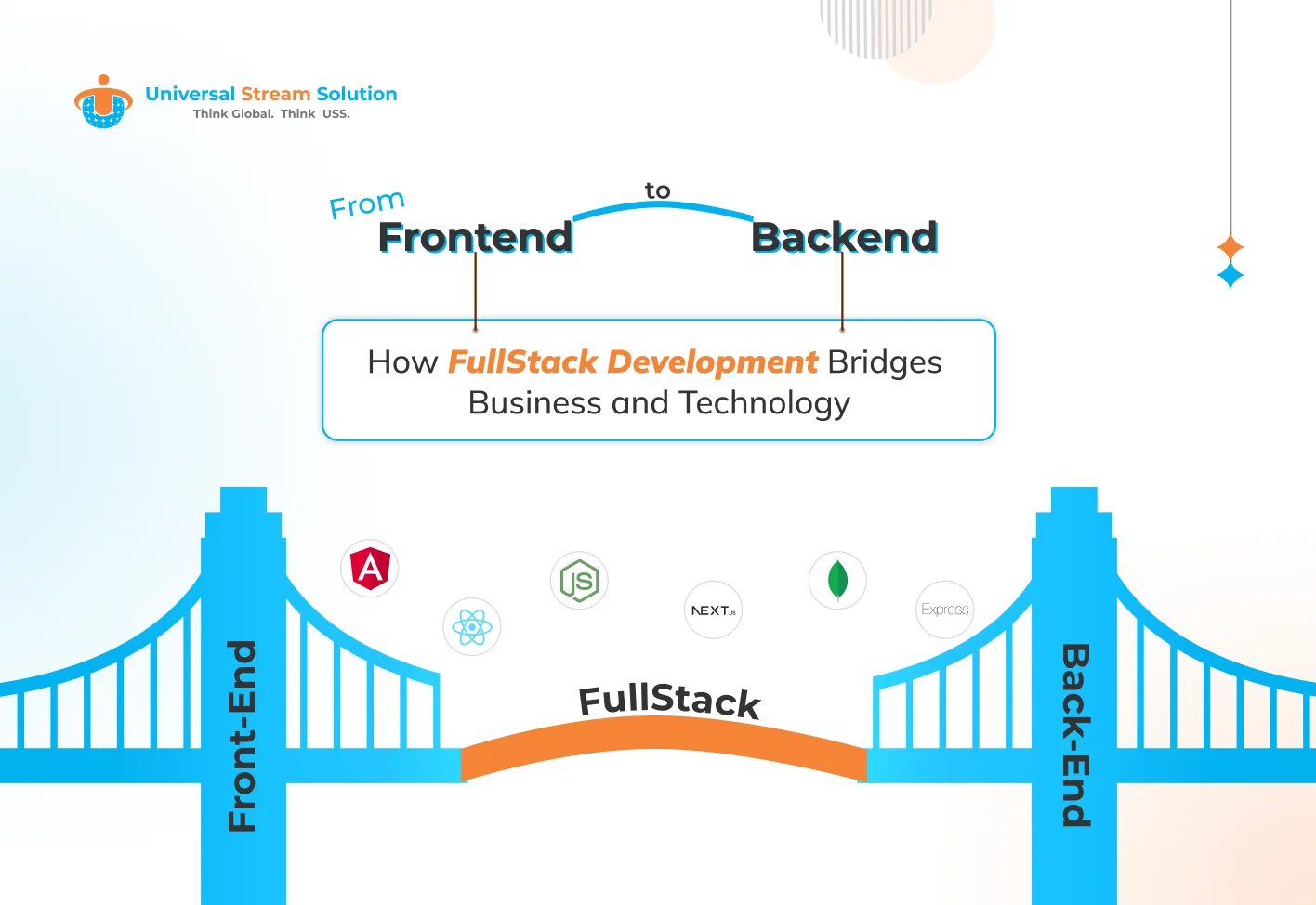
From Frontend to Backend: How Full Stack Development Bridges Business and Technology

 14th April, 2026
 6 min read


Table Of Contents
- Introduction
- Understanding Full Stack Development
- The Frontend: Where Business Meets the User
- The Backend: Powering Business Logic and Scalability
- Bridging the Gap Between Business and Technology
- Enhancing Agility in Product Development
- Cost Efficiency and Resource Optimization
- Driving Innovation Through Integration
- Real-World Business Impact of Full Stack Development
- Challenges and Considerations
- The Future of Full Stack Development
- Conclusion: A Strategic Advantage for Modern Businesses
Introduction
In today’s fast-evolving digital landscape, businesses are no longer just supported by technology—they are built on it. From customer-facing applications to internal operational systems, every digital product represents a direct connection between business goals and technical execution. This is where full stack development emerges as a powerful bridge.
Full stack development is not just about writing code for both frontend and backend. It represents a holistic approach to building digital solutions that align user experience, system performance, and business objectives. A full stack developer understands the complete lifecycle of an application, enabling seamless communication between stakeholders, faster execution, and better outcomes.
1. Understanding Full Stack Development
Full stack development refers to the ability to work across both the frontend (client-side) and backend (server-side) of an application.
a. Frontend Development focuses on what users see and interact with—interfaces, design, responsiveness, and usability.
b. Backend Development deals with data processing, server logic, APIs, and database management.
A full stack developer combines both skill sets, along with knowledge of deployment, security, and performance optimization.
This dual capability eliminates silos between teams and ensures that applications are built with a unified vision rather than fragmented efforts.
2. The Frontend: Where Business Meets the User
The frontend is the first point of contact between a business and its customers. It directly impacts brand perception, user satisfaction, and conversion rates.
A well-designed frontend:
- Enhances user engagement
- Improves accessibility and usability
- Builds trust and credibility
- Drives business metrics like sales and retention
From a business perspective, frontend development is not just about aesthetics—it’s about delivering value. Every button, animation, and interaction should guide the user toward a desired outcome, whether that’s making a purchase, signing up, or consuming content.
Full stack developers understand how frontend decisions affect backend performance and vice versa, ensuring that user experience is not compromised by technical limitations.
3. The Backend: Powering Business Logic and Scalability
While the frontend captures attention, the backend ensures everything works smoothly behind the scenes. It handles:
- Data storage and retrieval
- Authentication and authorization
- Business rules and workflows
- Integration with third-party systems
- Performance and scalability
For businesses, backend systems are critical for maintaining reliability and efficiency. A poorly designed backend can lead to slow performance, security vulnerabilities, and operational bottlenecks.
Full stack developers understand how frontend decisions affect backend performance and vice versa, ensuring that user experience is not compromised by technical limitations. This is especially important in enterprise software development solutions, where seamless integration, scalability, and performance are critical to delivering efficient and reliable business applications.
4. Bridging the Gap Between Business and Technology
One of the biggest challenges organizations face is the disconnect between business teams and technical teams. Business leaders think in terms of outcomes, while developers often focus on implementation details.
Full stack development bridges this gap in several ways:
Unified Perspective
Full stack developers understand both user experience and system architecture. This allows them to translate business requirements into technical solutions more effectively.
Faster Decision-Making
Instead of waiting for multiple teams to coordinate, a full stack approach enables quicker iterations and faster time-to-market.
Improved Communication
With knowledge across the stack, developers can communicate more clearly with designers, product managers, and stakeholders, reducing misunderstandings.
End-to-End Ownership
Full stack developers take responsibility for the entire application, ensuring consistency, quality, and alignment with business goals.
5. Enhancing Agility in Product Development
In a competitive market, speed and adaptability are crucial. Businesses need to launch quickly, gather feedback, and iterate continuously.
Full stack development supports agile methodologies by:
- Reducing dependencies between teams
- Enabling rapid prototyping
- Allowing quick bug fixes and updates
- Supporting continuous integration and deployment
This agility helps businesses stay ahead of competitors and respond effectively to changing market demands.
6. Cost Efficiency and Resource Optimization
Hiring separate frontend and backend teams can be expensive and resource-intensive. Full stack developers offer a cost-effective alternative, especially for startups and growing businesses.
Benefits include:
- Fewer resources required for development
- Reduced overhead in team coordination
- Faster project completion
- Lower maintenance costs
While full stack developers may not replace specialized experts in complex scenarios, they provide significant value in building and maintaining most applications.
7. Driving Innovation Through Integration
Modern applications often rely on multiple technologies, including cloud platforms, APIs, AI tools, and third-party services. Full stack developers play a crucial role in integrating these components seamlessly.
They ensure that:
- Frontend interfaces communicate effectively with backend services
- Data flows smoothly across systems
- New features can be added without disrupting existing functionality
This ability to integrate and innovate is essential for businesses looking to scale and differentiate themselves.
8. Real-World Business Impact of Full Stack Development
Full stack development directly influences key business outcomes:
- Customer Experience: Faster, smoother, and more intuitive applications
- Operational Efficiency: Streamlined processes and reduced downtime
- Scalability: Systems that grow with the business
- Revenue Growth: Improved conversion rates and user retention
Companies that adopt a full stack development with cloud backend approach often see better alignment between their digital products and strategic goals.
9. Challenges and Considerations
While full stack development offers many advantages, it also comes with challenges:
- Keeping up with rapidly evolving technologies
- Balancing depth and breadth of knowledge
- Avoiding burnout due to wide responsibilities
- Ensuring quality across all layers of development
Businesses must support full stack developers with proper tools, training, and collaboration frameworks to maximize their effectiveness.
10. The Future of Full Stack Development
As technology continues to evolve, the role of full stack developers is becoming even more critical. Trends shaping the future include:
- Increased adoption of cloud-native architectures
- Rise of low-code and no-code platforms
- Integration of AI and automation in development workflows
- Greater emphasis on security and performance
Full stack developers who continuously upskill and adapt will remain at the forefront of innovation, driving both technical excellence and business success.
Conclusion: A Strategic Advantage for Modern Businesses
Full stack development is more than a technical skill set—it is a strategic capability that connects business vision with technological execution. By bridging the gap between frontend user experiences and backend systems, full stack developers enable organizations to build cohesive, scalable, and impactful digital solutions. If you're looking to implement these strategies effectively, you can book a free software consultation to explore the best approach for your business needs.
In a world where technology defines competitive advantage, businesses that embrace full stack development are better positioned to innovate, adapt, and grow. It’s not just about building applications—it’s about building solutions that truly align with business goals and deliver real value.

Arzeb Mansuri

Arzeb Mansuri is a full-stack developer with expertise in Next.js, React.js, Node.js, TypeScript, JavaScript and PHP, delivering high-quality digital solutions in fast-moving environments. With a strong focus on building user-centric web applications, Arzeb helps organizations enhance their digital presence and operational performance.
Related Blogs



 +91 9638225549
 sales@universalstreamsolution.com


