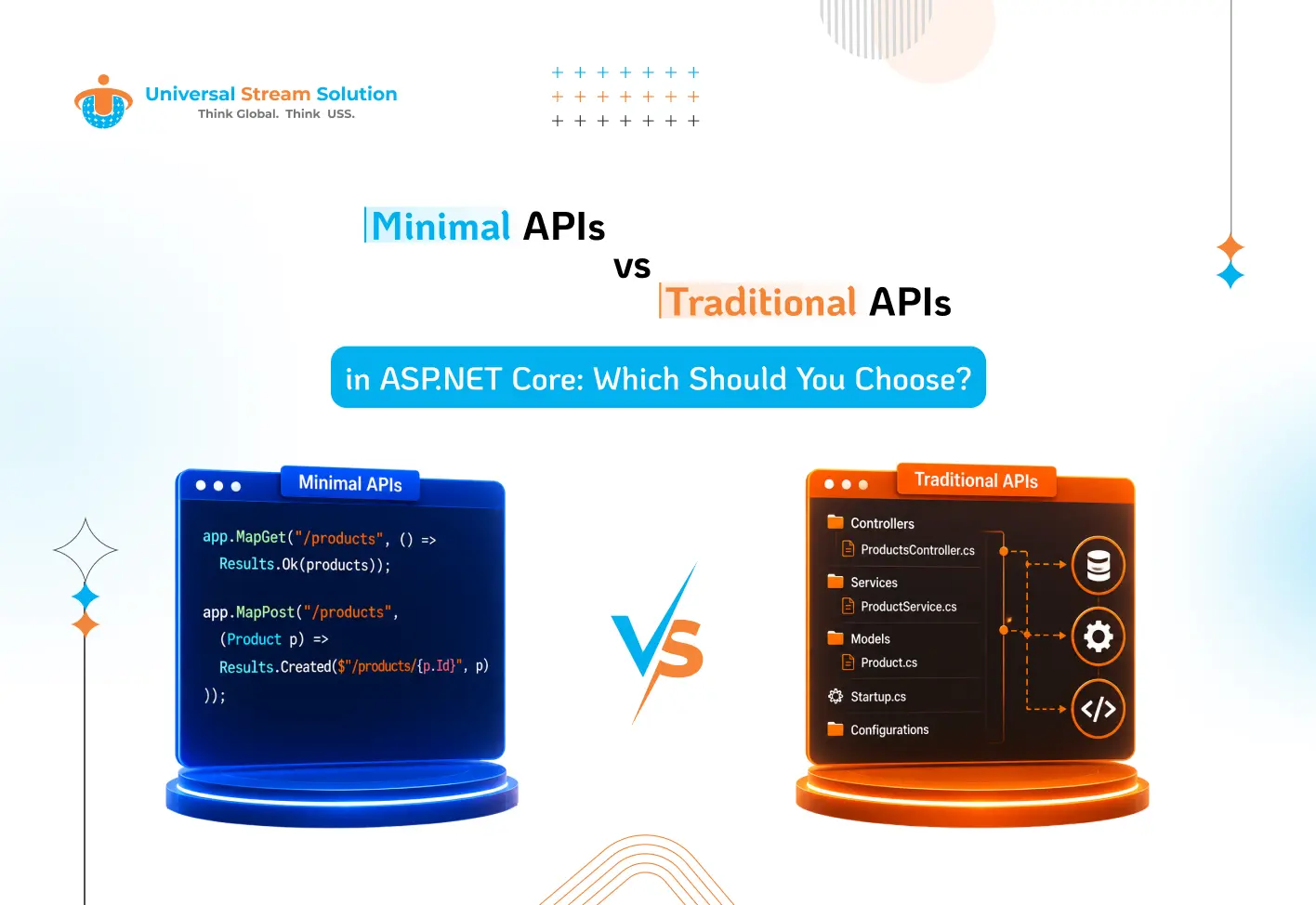
Minimal APIs vs Traditional APIs in ASP.NET Core: Which Should You Choose?

 16th July, 2026
 6 min read


Table Of Contents
- Introduction
- What Are Minimal APIs in ASP.NET Core?
- What Are Traditional APIs in ASP.NET Core?
- Why Are APIs Important in Modern Application Development?
- Minimal APIs vs Traditional APIs: Architecture Differences
- Development Speed and Productivity
- Performance Comparison Between Minimal APIs and Traditional APIs
- When Should You Choose Minimal APIs?
- When Should You Choose Traditional APIs?
- Can Minimal APIs and Traditional APIs Work Together?
- Best Practices for ASP.NET Core API Development
- Final Thoughts
Introduction
APIs have become a critical component of modern software development. They allow different applications, platforms, and services to communicate efficiently while enabling businesses to build scalable digital solutions.
When developing APIs using ASP.NET Core, developers often face an important architectural decision: whether to use Minimal APIs or Traditional APIs.
Both approaches are officially supported by Microsoft and provide powerful capabilities for building modern web applications. However, they are designed with different goals in mind.
Minimal APIs focus on simplicity, faster development, and lightweight architecture. They are designed to help developers build APIs with less code and fewer configurations.
Traditional APIs, based on the MVC controller architecture, focus on structured development, maintainability, and enterprise-level scalability.
Choosing the right API architecture depends on several factors, including application complexity, team size, security requirements, future growth, and maintenance expectations.
This article explains the differences between Minimal APIs and Traditional APIs in ASP.NET Core and helps you understand which approach is the right choice for your project.
1. What Are Minimal APIs in ASP.NET Core?
Minimal APIs are a lightweight approach for building HTTP APIs introduced in ASP.NET Core 6.
The main purpose of Minimal APIs is to simplify API development by reducing the amount of code and configuration required. Instead of relying on traditional controllers, Minimal APIs allow developers to define API routes and application behavior with a simpler structure.
This approach is designed for developers who want to create fast, efficient, and easy-to-maintain APIs without unnecessary complexity.
Minimal APIs are commonly used for applications where speed and simplicity are important, such as:
- Microservices
- Cloud-native applications
- Internal business tools
- Small backend services
- Prototype applications
- Lightweight web APIs
The lightweight nature of Minimal APIs makes them an attractive option for modern development environments where teams need to deliver solutions quickly.
2. What Are Traditional APIs in ASP.NET Core?
Traditional APIs are based on the conventional MVC architecture used widely in ASP.NET Core development.
In this approach, API functionality is organized using controllers, services, models, and other architectural components. Each layer has a specific responsibility, which improves code organization and application maintainability.
Traditional APIs have been widely adopted for enterprise applications because they provide a clear development structure and support complex business requirements.
They are commonly used for:
- Enterprise software
- Healthcare applications
- Banking platforms
- E-commerce systems
- CRM and ERP solutions
- Large SaaS platforms
Traditional APIs provide developers with a mature architecture that supports advanced requirements such as complex authorization, API versioning, extensive validation, and large-scale integrations.
3. Why Are APIs Important in Modern Application Development?
Modern businesses depend on connected systems. Applications need to communicate with mobile apps, websites, cloud platforms, payment systems, third-party services, and internal tools. As technology requirements continue to evolve, businesses are exploring why upgrade to .NET 8 to improve application performance, security, scalability, and long-term support. .NET 8 provides advanced capabilities that help organizations build modern, reliable, and high-performing applications that can adapt to changing business needs.
APIs act as the bridge between these systems.
A well-designed API helps businesses achieve:
- Better application integration
- Improved scalability
- Faster data exchange
- Enhanced user experiences
- Easier software maintenance
- Support for multiple platforms
The API architecture you choose directly affects how easily your application can grow and adapt to future business needs.
4. Minimal APIs vs Traditional APIs: Architecture Differences
Architecture is one of the biggest differences between Minimal APIs and Traditional APIs.
Minimal APIs follow a lightweight architecture that removes many traditional development layers. This makes the development process simpler and reduces the amount of code required.
This approach works well when applications have limited complexity and developers need to create APIs quickly.
Traditional APIs follow a structured MVC-based architecture. This approach separates application responsibilities into different components, allowing developers to organize business logic, data handling, and API operations effectively.
For large applications, this separation provides better control and improves long-term maintainability.
5. Development Speed and Productivity
Development speed is one of the strongest advantages of Minimal APIs.
Because Minimal APIs require less configuration and fewer files, developers can build and deploy API services faster. This makes them valuable for projects where quick delivery is a priority. Businesses working with a remote development team services model can also benefit from this streamlined approach, as distributed teams can collaborate more efficiently, reduce development complexity, and deliver scalable API solutions faster.
Startups and development teams working on MVPs often prefer Minimal APIs because they allow teams to validate ideas and release products faster.
Traditional APIs require more initial development effort because developers need to establish controllers, services, and project structures.
However, this additional setup provides benefits when applications become larger. The organized structure helps developers add new features without creating unnecessary complexity.
For short-term projects, Minimal APIs can improve productivity. For long-term enterprise solutions, Traditional APIs often provide better development stability.
6. Performance Comparison Between Minimal APIs and Traditional APIs
Performance is another important consideration when selecting an API architecture.
Minimal APIs generally provide excellent performance because they have a smaller request processing pipeline. They reduce unnecessary overhead, which can result in faster response times and lower resource consumption.
This makes them suitable for:
- High-performance services
- Lightweight applications
- Cloud-based applications
- Microservices architecture
Traditional APIs also provide strong performance and can handle large-scale applications effectively.
Although they include additional MVC features that may introduce slightly more processing overhead, the difference is often insignificant for most business applications.
In real-world applications, performance depends on multiple factors, including:
- Database optimization
- Infrastructure quality
- Application design
- Caching strategy
- Network performance
Therefore, businesses should consider overall architecture rather than choosing an API approach based only on performance.
Code Organization and Maintainability
Code organization becomes increasingly important as applications grow.
Minimal APIs provide simplicity, which is beneficial for smaller applications. Developers can quickly understand the project structure and make changes easily.
However, when an application grows with hundreds of endpoints and complex business rules, maintaining a lightweight structure can become challenging without proper organization.
Traditional APIs provide better separation of responsibilities.
By organizing code into controllers, services, repositories, and models, developers can maintain cleaner architecture and reduce complexity.
For organizations with multiple developers working on the same project, Traditional APIs often provide better collaboration and maintainability.
Scalability Considerations
Both Minimal APIs and Traditional APIs can support scalable applications.
Minimal APIs work well for applications that use:
- Microservices architecture
- Independent services
- Cloud deployment
- Container-based infrastructure
Their lightweight nature makes them efficient for applications where multiple small services communicate with each other.
Traditional APIs are better suited for large-scale applications that require:
- Complex business workflows
- Multiple integrations
- Large development teams
- Long-term feature expansion
Businesses building enterprise-level platforms usually prefer Traditional APIs because they provide a structured foundation for future growth.
Security Features
Security is a critical requirement for modern applications.
Both Minimal APIs and Traditional APIs support important security features, including:
- Authentication
- Authorization
- JWT-based security
- OAuth integration
- HTTPS communication
- Role-based access control
Traditional APIs often provide easier management of complex security requirements because their structured architecture allows security rules to be applied consistently across different application modules.
Minimal APIs can also provide strong security but may require additional planning as applications become more complex.
7. When Should You Choose Minimal APIs?
Minimal APIs are a good choice when your project requires simplicity, speed, and lightweight architecture.
Choose Minimal APIs for:
- Small and medium-sized applications
- Microservices
- Internal tools
- Cloud-native applications
- Rapid prototypes
- Simple REST APIs
- Backend services with limited complexity
They are ideal when developers need to build efficient APIs without unnecessary architectural overhead.
8. When Should You Choose Traditional APIs?
Traditional APIs are recommended when your application requires structure, scalability, and long-term support.
Choose Traditional APIs for:
- Enterprise applications
- Healthcare software
- Financial systems
- Large SaaS platforms
- Business management software
- Applications with complex workflows
They provide better support for projects where multiple teams collaborate and where applications are expected to evolve for many years.
9. Can Minimal APIs and Traditional APIs Work Together?
Yes, ASP.NET Core supports a hybrid approach where organizations can use both API styles within the same application.
Many businesses combine both approaches based on specific requirements.
For example, lightweight services can use Minimal APIs, while complex business modules can continue using Traditional APIs.
This allows organizations to achieve faster development without sacrificing maintainability.
10. Best Practices for ASP.NET Core API Development
Regardless of the API approach you choose, following best practices is essential for building reliable applications.
Recommended practices include:
- Maintain clean architecture principles
- Separate business logic from API endpoints
- Implement proper authentication and authorization
- Use dependency injection effectively
- Add proper error handling
- Optimize database operations
- Implement logging and monitoring
- Document APIs properly
- Follow secure coding practices
- Perform regular performance testing
A well-designed API architecture helps businesses create applications that are secure, scalable, and easier to maintain.
Final Thoughts
Minimal APIs and Traditional APIs both provide powerful solutions for building applications with ASP.NET Core.
Minimal APIs are an excellent choice for lightweight applications, microservices, and projects that prioritize speed and simplicity.
Traditional APIs remain the preferred choice for enterprise applications that require structured architecture, advanced features, and long-term scalability.
There is no universal answer to which approach is better. The right choice depends on your application's requirements, development team, complexity, and future growth plans.
For many modern applications, a hybrid approach can provide the best balance by combining the simplicity of Minimal APIs with the scalability and maintainability of Traditional APIs. Businesses looking to select the right API architecture can book a technology consultation with experienced experts to evaluate their project requirements, scalability goals, and long-term development strategy.
By carefully evaluating your project goals, you can choose the right ASP.NET Core API architecture that supports both current requirements and future business growth.

Bharat Katariya

Bharat Katariya is a seasoned executive at Universal Stream Solution LLC, bringing a strong track record of leadership and commercial strategy. With robust experience in driving business growth and operational transformation, he empowers organizations to build scalable, efficient solutions. Bharat is committed to delivering strategic value through innovation, collaboration, and integrity.
Related Blogs





 +91 9638225549
 sales@universalstreamsolution.com


